

Posted by Editorial Team on Oct 12, 2026
Why Durability Matters for Wheel Covers
Table of Contents
- Why Wheel Cover Durability Decides Whether You Get Protection or Just Looks
- What Wheel Covers Are Actually Doing on Your Vehicle
- Wheel Cover Materials: What Plastic and Metal Actually Deliver
- How Long Do Wheel Covers Last, and What Shortens Their Life
- Wheel Cover Maintenance That Adds Years, Not Weeks
- Fit and Installation: Where Durability Quietly Fails
- Aerodynamic Wheel Covers for Electric Vehicles: What Durability Adds
- Durability vs. Cost: When Replacing Beats Repairing
- A Practical Durability Checklist Before You Buy
- Conclusion: Durability Is the Spec That Keeps Paying You Back
- Frequently Asked Questions
Last Updated: October 12, 2026
Why Wheel Cover Durability Decides Whether You Get Protection or Just Looks
Durability is the single spec that decides whether wheel covers protect your wheels for years or fall off in months. The global car wheel cover market was valued at USD 2,226.6 million in 2025, according to WheelCovers.com's 2026 buyer's guide, and it is projected to grow at a 4.6% compound annual growth rate through 2035. That growth tells you something simple: drivers keep buying covers. What it doesn't tell you is how many of those covers fail early.
At WheelCovers.Com, we've supplied hubcaps and wheel covers for nearly 50 years, and we've seen the same pattern repeat. A cheap cover that cracks, fades, or rattles loose costs more over time than a durable one bought once.
Below, we'll show you exactly what durability protects, how to judge it before you buy, and how to make a good set last longer.
What Wheel Covers Are Actually Doing on Your Vehicle
A wheel cover is a snap-on or bolt-on panel that fits over a steel wheel to restore appearance and shield the wheel beneath it. That shield does two jobs at once: it makes the car look finished, and it keeps road junk away from parts you rarely inspect.
Most shoppers only think about the first job. The second one is where durability earns its keep.
The Protection Barrier: Dust, Debris, Moisture, and Corrosion
A wheel cover acts as a barrier between your wheel and everything the road throws at it. Brake dust, road grime, and foreign particles settle into every crevice of an exposed steel wheel. Moisture does the slow damage. Trapped water and road salt speed up corrosion on bare steel, and once rust starts, it spreads under the paint.
A cover in good condition blocks most of that. A cracked or loose cover does the opposite. It traps moisture against the wheel and lets grit grind between the cover and the rim.
Rims, Lug Nuts, and the Parts You Can't See
Steel wheels and rims take the worst of it. So do lug nuts, which sit in a recess that collects water and debris. A cover that stays put keeps that recess cleaner and drier.
Wheel Cover Materials: What Plastic and Metal Actually Deliver
Material choice drives durability more than any other factor, but "plastic vs. metal" is too coarse to be useful. Two covers made from the same plastic can differ by years of service life depending on wall thickness, clip geometry, and finish system. What matters is how each material behaves under the four stresses a cover actually faces: impact, flex, heat, and UV.
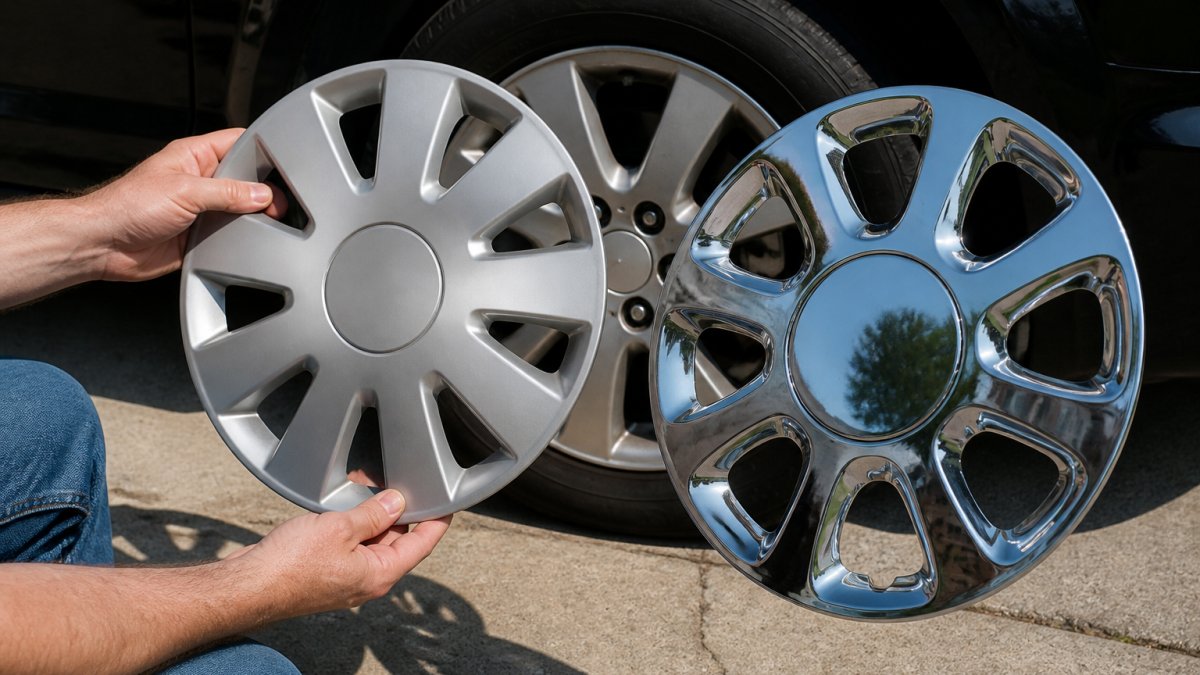
ABS Plastic, Polycarbonate, and Chrome-Plated Options
ABS plastic is the most common material in aftermarket wheel covers. It is tough for the price, resists impact reasonably well, and can be molded into accurate factory-style shapes. Its weakness is UV and cold. Prolonged sun exposure breaks down the surface over time, and ABS gets noticeably more brittle as temperatures drop, which is why clips are the first thing to snap in a hard freeze.
Polycarbonate costs more but handles impact better and holds its shape across a wider temperature swing. It flexes further before it cracks, which matters most at the clip mounts where every cover concentrates stress. If you live somewhere with hard winters or rough roads, it is worth the step up.
Chrome-plated covers use a metal or plastic base with a bright finish. The plating is what fails first. Chips in the chrome let moisture reach the base, and that is where pitting starts. Once pitting begins, it spreads under the plating and the finish lifts in flakes.
How to Judge Material Quality Before You Buy
Since most listings do not publish test data, judge the physical cues that correlate with durability. A common pattern among buyers who get long service life is checking these before ordering:
- Wall thickness at the rim. A cover that flexes easily between your fingers at the outer edge will flex just as easily against a curb. Stiffer edges resist deformation.
- Clip count and clip thickness. More clips spread retention load across more points. Thicker clip roots resist cracking where the clip meets the cover body.
- Reinforced edges. A rolled or thickened outer lip resists the edge cracking that starts most failures.
- Finish consistency. A uniform finish with no thin spots or bubbles signals a controlled coating process. Thin spots are where UV and moisture attack first.
- Weight as a rough proxy. Between two covers of the same size and style, the heavier one usually has more material in the places that matter.
Durability Testing and Measurable Performance
Durability claims become useful when they map to a test. The indicators worth asking about, or inferring from design, are:
- Impact resistance: how the cover behaves when struck at the edge, the way a curb or road debris strikes it. Covers that shatter rather than deform fail this test.
- UV exposure: how long the finish and the base material hold up under continuous sun. Fading is cosmetic; embrittlement is structural, and it is the one that causes clips to snap.
- Temperature tolerance: how the material behaves at both ends of the range. Cold makes plastic brittle; heat can warp a cover enough that it no longer seats.
- Clip-retention strength: how much force it takes to pull a seated cover off the wheel. This is the single best predictor of whether a cover stays on at highway speed.
How Long Do Wheel Covers Last, and What Shortens Their Life
Most quality wheel covers last several years, but driving conditions and material quality move that number a lot. There is no single lifespan figure that applies to every car, because the variables differ so much from driver to driver. What we can do is map the specific conditions that shorten service life and match them to the right cover for your situation.
How Driving Conditions Affect Service Life
Different conditions attack a cover in different ways. Matching your cover to your dominant condition is the single most effective durability decision you can make.
- Potholes and rough pavement. Each strike flexes the cover and loads the clips. Repeated flexing fatigues the material at the clip roots until a crack forms. If this is your daily drive, prioritize polycarbonate and reinforced clip mounts.
- Gravel and unpaved roads. Debris strikes the outer edge and face at speed. Edge chips become crack starters. Look for a rolled or thickened outer lip.
- Road salt and winter weather. Salt holds moisture against the finish and accelerates corrosion on any exposed metal, including clip hardware and the wheel beneath. Rinse covers and wheel wells after winter storms, and favor finishes that resist chipping.
- Heat and direct sun. UV breaks down the finish and embrittles the base material. A car parked outside year-round sees far more UV load than a garaged one. Fade-resistant finishes and polycarbonate hold up better here.
- Frequent curb contact. This is the most common cause of premature failure. Curb strikes crack clips and deform edges, and a deformed edge no longer seats evenly.
Failure Signs: Cracking, Loose Fit, and Retention Clip Damage
Catch these early and you can often replace one cover instead of a set. The progression is predictable: finish damage leads to material damage, material damage leads to fit damage, and fit damage leads to loss.
- Hairline cracks near the outer edge or around clip mounts
- A cover that rocks or spins when you push it by hand
- Missing or bent retention clips
- Faded or peeling finish that signals the material is breaking down
- Rattling at low speed, which usually means a clip has lost tension
- Warping that keeps the cover from seating flush against the wheel
When to Replace Rather Than Repair
Structural damage is not repairable in any reliable way. Cracks at the clip mounts, missing clips, and warped edges will fail again at the same spot, often sooner than the original failure. Finish damage is different. A scuffed or faded cover that still seats tightly is a candidate for cleaning and touch-up, and it will keep protecting the wheel while you decide on a replacement.
The practical rule: if the cover still locks firmly to the wheel, it is still doing its job. If it rocks, rattles, or has lost a clip, it is no longer protecting anything and it is a risk to other drivers.
Condition-Specific Selection Advice
Use your dominant driving condition to pick the cover, not the other way around:
- Heavy road salt and hard freezes: polycarbonate base, chip-resistant finish, thick clip roots. Cold brittleness is the enemy here.
- Rough pavement and potholes: polycarbonate with reinforced clip mounts and a stiff outer edge.
- Gravel and unpaved roads: rolled outer lip and a finish that resists edge chipping.
- Long sun exposure: fade-resistant finish and a material that resists UV embrittlement.
- Frequent curb contact: vehicle-specific fit with a precise seat, so the cover sits flush and resists deformation.
Wheel Cover Maintenance That Adds Years, Not Weeks
Regular cleaning is the cheapest durability upgrade you can make. Dirt and brake dust don't just look bad. They hold moisture against the finish and grind into the surface every time the wheel turns. A few minutes of care every couple of weeks prevents most of the damage that shortens cover life.
Cleaning by Material Without Stripping the Finish
Match your method to the material. Harsh cleaners and abrasive brushes do more harm than the dirt you're removing.
- Plastic covers: mild soap, warm water, soft cloth. Skip solvents.
- Chrome-plated covers: soap and water, then a soft dry cloth. Avoid abrasive polishes.
- Painted finishes: same as chrome. No scrubbing pads.
- All materials: rinse wheel wells first so you're not splashing grit onto the cover
Check retention clips every time you wash. A quick push test tells you whether a clip is losing grip before it fails completely.
Fit and Installation: Where Durability Quietly Fails
The most durable cover in the world fails fast if it doesn't fit. Poor fit is the leading cause of premature loss, and it's almost always a sizing or installation problem rather than a materials problem. Get the fit right and most other durability concerns take care of themselves.
Vehicle-Specific Fit vs. Universal Fit
Vehicle-specific fit means the cover is made for your exact wheel size and style. It seats properly, the clips engage where they're supposed to, and it stays put.
Universal fit covers are designed to span multiple wheel sizes. They're cheaper and easier to stock, but the trade-off is a less precise seat. On some wheels they work fine. On others they never sit quite right, and a cover that doesn't seat fully will work loose.
| Fit Type | How It Seats | Durability Outlook | Best For |
|---|---|---|---|
| Vehicle-specific | Exact wheel match | Holds clips under tension | Most drivers |
| Universal | Adjustable to a range | Depends on wheel shape | Temporary or budget use |
Secure Installation and Checking Retention Clips
Installation is where a good cover becomes a durable one.
- Clean the wheel and let it dry completely.
- Line up the valve stem cutout before you press anything into place.
- Seat one clip at a time, working around the wheel.
- Press evenly until you hear or feel each clip engage.
- Push and pull the cover by hand to confirm it's locked.
- Recheck after the first drive and again a week later.
Aerodynamic Wheel Covers for Electric Vehicles: What Durability Adds
Aerodynamic wheel covers for electric vehicles smooth airflow over the wheel and can affect range, though the size of that effect depends on driving conditions. A comparison article notes that an official hubcap can affect efficiency without the change being visible to the driver, per Yeslak's comparison of wheel cover options. That's exactly why durability matters more on an EV, not less.
A cover that warps, cracks, or sits loose stops doing its aerodynamic job. Worse, a loose cover adds drag and noise. For EV owners, a durable set isn't cosmetic. It's part of keeping the efficiency gain you bought the covers for.
Durability vs. Cost: When Replacing Beats Repairing
Replacing usually beats repairing once a cover shows structural damage. Cracks at the clip mounts, missing clips, and warped edges can't be fixed reliably, and a repaired cover tends to fail again at the same spot. Finish damage is different. A scuffed or faded cover that still seats tightly is a candidate for cleaning and touch-up.
Cost per year is the number that matters, not sticker price. A cheap set you replace every season costs more over three years than a durable set bought once. That's the case we make to customers every day, and it's why we stock many original and custom parts instead of whatever's cheapest.
A Practical Durability Checklist Before You Buy
Use this list before you order. It takes two minutes and prevents most of the returns we see.
- Confirm your exact wheel size, not just your vehicle model
- Choose vehicle-specific fit over universal where possible
- Check material: polycarbonate for harsh climates, ABS for mild ones
- Inspect clip design and count before buying
- Look for reinforced edges and thick clip mounts
- Match finish type to how much sun the car sees
- Verify the seller lists the exact year, make, and model
- Confirm the return policy before checkout
Conclusion: Durability Is the Spec That Keeps Paying You Back
Durability is the one wheel cover spec that keeps delivering after the shine wears off. It protects rims, lug nuts, and steel wheels from dust, moisture, and corrosion. It holds aerodynamic gains on an EV. And it keeps you from buying the same part twice.
At WheelCovers.Com, we've spent nearly 50 years helping drivers find covers that fit right the first time. Our inventory of over 1 million hubcaps, wheel covers, wheel skins, and wheel simulators covers vehicles old and new, with nationwide shipping and easy online ordering.
Get started with WheelCovers.Com and find a set built to stay on your wheels, season after season.
Frequently Asked Questions
What makes a wheel cover durable?
Three things decide it: material quality, retention clip design, and fit. A cover made from impact-resistant plastic with sturdy clips holds up far better than a thin, universal cover that rattles on the wheel. Vehicle-specific fit matters too, because a cover that sits loosely flexes constantly and cracks faster. Check that the cover matches your wheel size, that the clips are intact, and that the finish resists fading. Those three checks tell you more about durability than any marketing claim on the box.
How long do wheel covers typically last?
Service life depends on material, driving conditions, and care, so there is no single number that applies to every vehicle. Covers driven mostly on smooth roads and cleaned regularly last considerably longer than those exposed to harsh winters, road salt, and frequent curb contact. Watch for the failure signs instead of counting months: hairline cracks, a loose fit, missing retention clips, or a finish that has gone dull. Replacing a cover at the first sign of cracking prevents it from coming off at speed.
Do wheel covers protect wheels from road debris?
Yes. A properly fitted cover acts as a protection barrier over the steel wheel, keeping dust, debris, moisture, and road grime away from the rim surface and lug nuts. That reduces the chance of corrosion building up on exposed metal. The protection only works while the cover stays seated, which is why durability and secure installation go together. A cracked or loose cover lets moisture and foreign particles reach the wheel, so inspect covers after any hard impact.
Can wheel covers affect a vehicle's aerodynamics?
They can, but the size of the effect varies. Any efficiency benefit depends on how and where the vehicle is driven, so gains should not be treated as uniform across all conditions. For electric vehicle owners, a cover that stays securely fitted delivers whatever aerodynamic benefit it offers more consistently than one that loosens over time.