

Oct 08, 2026
Top Rated Wheel Covers for Trucks: 2026 Buyer's Guide
Table of Contents
- What Makes a Wheel Cover Top Rated for Trucks
- How to Measure Wheel Size for Hubcaps Before You Buy
- 16 in Wheel Covers: The Most Common Truck Fitment
- Truck Wheel Skins vs Standard Hubcaps: Which Holds Up Better
- Stainless Steel, Chrome Plated, and Polished Aluminum Compared
- Aerodynamic Wheel Covers and Real Fuel Savings Data
- Retention Systems, Installation, and Avoiding Wheel Damage
- Common Fitment Mistakes That Cost Truck Owners Money
- Conclusion: Choosing Top Rated Wheel Covers for Trucks
- Frequently Asked Questions
Last Updated: October 7, 2026
What Makes a Wheel Cover Top Rated for Trucks
A top rated wheel cover for trucks is a direct-fit cover that matches your rim diameter, locks onto the steel wheel with a secure retention system, and resists corrosion through years of road spray and sun exposure. Fuel savings data now backs up what truck owners have long suspected: aerodynamics matter. According to FlowBelow's independent third-party testing of aerodynamic wheel cover kits, wheel covers cut tractor fuel consumption by 0.93% and trailer consumption by 0.81%, a combined 1.74% gain.
That number is small on a single fill-up and significant across a fleet year. At WheelCovers.Com, we have watched this shift firsthand. Our inventory of over 1 million hubcaps and wheel covers, built across nearly 50 years in business, now includes more aerodynamic styles than at any point in our history.
Three things separate a top rated cover from a cheap one: material, fitment, and retention. Get all three right and the cover outlasts the truck. Get any one wrong and you are buying replacements twice a year.
How to Measure Wheel Size for Hubcaps Before You Buy
Measure the rim diameter at the point where the tire bead seats, not across the outer edge of the wheel. That single measurement determines every fitment decision that follows.
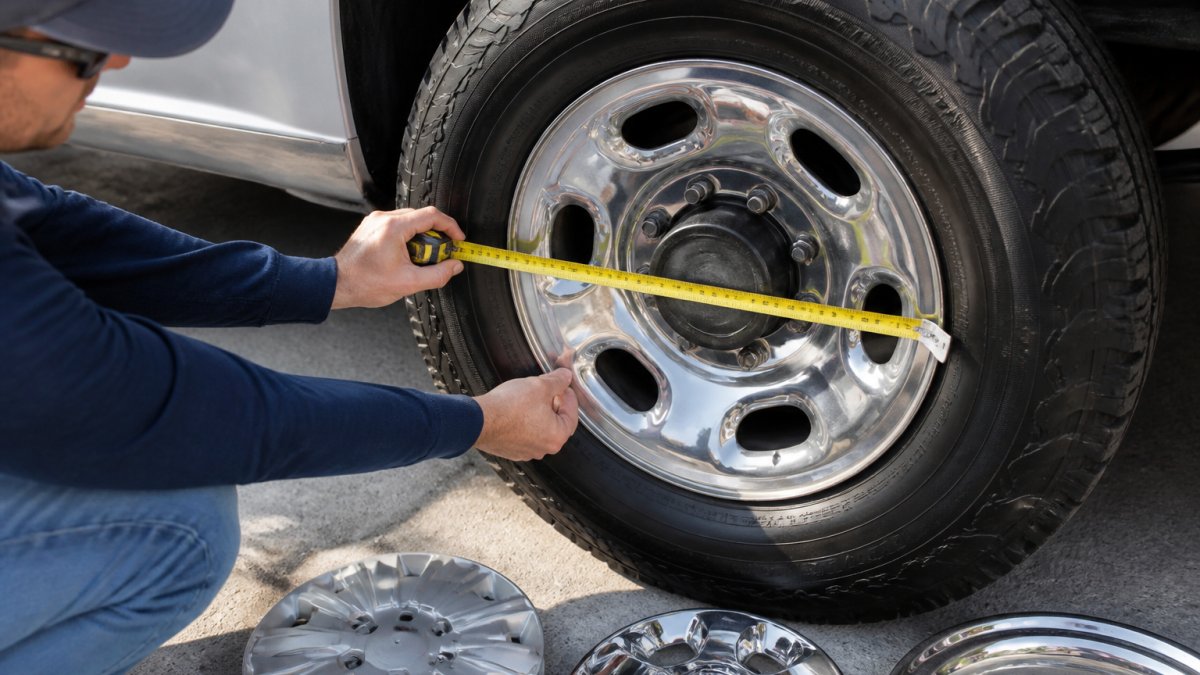
Reading the Tire Sidewall and Confirming Rim Diameter
The tire sidewall carries the rim size in the last number of the size code. A tire marked 265/70R16 sits on a 16-inch rim. The "R" confirms radial construction and the number after it is your wheel diameter.
Confirm that number with a tape measure across the wheel face. Measure from the inner bead seat on one side to the inner bead seat on the other. If the sidewall says 16 and the tape says 16, you have your fitment.
Two other numbers matter. Bolt pattern tells you the lug spacing, and offset tells you how far the wheel sits in or out of the fender. Neither changes the cover diameter, but both affect whether a deep dish or step lip profile clears your brake hardware.
16 in Wheel Covers: The Most Common Truck Fitment
The 16-inch wheel is the single most common truck fitment on the road, which makes 16 in wheel covers the highest-volume category we stock. If you drive a work truck, a van, or most full-size pickups from the past two decades, there is a strong chance your rim measures 16 inches.
That popularity cuts both ways. Selection is deep, so you can find OEM-style covers, chrome plated finishes, and polished aluminum options without hunting. It also means counterfeits and thin-gauge knockoffs flood the market, because volume attracts cheap copies.
Stick to covers with a metal clip retention system and a smooth lip that sits flush against the rim. A 16-inch cover that fits one truck brand often fits several, but always verify your bolt pattern and wheel profile before ordering.
| Rim Size | Common Applications | Cover Availability |
|---|---|---|
| 15-inch | Older pickups, some vans | Moderate |
| 16-inch | Most full-size trucks, work vans | Highest |
| 17-inch | Late-model trucks, SUVs | High |
| 19.5-inch | Heavy-duty commercial trucks | Specialized |
| 22.5-inch | Class 7-8 tractors and trailers | Specialized |
Truck Wheel Skins vs Standard Hubcaps: Which Holds Up Better
Truck wheel skins win on appearance and hold up better against road debris, while standard hubcaps win on price and ease of replacement. The right choice depends on what you are covering and how hard you use the truck.
A wheel skin is a full-face cover that mimics the look of an alloy wheel across the entire steel rim. It covers more surface area, so it hides more of the steel underneath. A standard hubcap covers only the center section, leaving the outer rim exposed.
For a work truck that sees gravel roads and job sites, skins protect more of the wheel. For a truck where covers get knocked off regularly, standard hubcaps cost less to replace and swap faster.
Neither option survives a curb strike. That is a driver problem, not a product problem.
Stainless Steel, Chrome Plated, and Polished Aluminum Compared
Stainless steel offers the strongest long-term value for heavy-duty trucks, chrome plating delivers the brightest finish, and polished aluminum sits between them on both cost and durability. RST-Steel's 2026 guidance on wheel covers for heavy-duty applications identifies stainless steel covers for 22.5-inch and 19.5-inch rims as the best long-term investment for commercial fleets.
Here is how the three materials actually differ in service:
- Stainless steel: Resists corrosion without a coating that can chip. Heavier, but the finish does not peel. The trade-off is weight and a slightly softer reflectivity than chrome.
- Chrome plated: Reflects light better than any other option. The plating can flake at deep scratches, exposing the base metal. Once a chip starts, road salt accelerates the spread.
- Polished aluminum: Lightweight and bright. Needs periodic polishing to hold its shine against road salt, and bare aluminum oxidizes into a dull haze if neglected.
Cross-Material Comparison by Fit, Finish, and Upkeep
Most product listings stop at the bullet points above. The table below is the part they skip: how each material behaves once it is on the truck.
| Attribute | Stainless Steel | Chrome Plated | Polished Aluminum |
|---|---|---|---|
| Base metal | Steel alloy with chromium content throughout | Steel or plastic substrate with a plated layer | Aluminum |
| Finish durability | Finish is the metal; no layer to peel | Plating can chip and flake at impact points | Finish is the metal; can oxidize and dull |
| Weight per cover | Heaviest | Moderate | Lightest |
| Corrosion behavior | Surface stains possible but does not perforate quickly | Base metal corrodes once plating breaks | Surface oxidation dulls shine; pitting possible in salt |
| Cleaning routine | Soap, water, occasional metal polish | Non-abrasive wash only; abrasives strip plating | Periodic aluminum polish to restore shine |
| Best use case | Daily-driven trucks in salt-belt states, fleets | Show trucks, classic and vintage styling, fair-weather rigs | Weight-sensitive builds, warm-climate trucks |
| Typical failure mode | Dents from curb strikes | Plating flake at scratches | Oxidation haze and pitting |
What Actually Determines Service Life
Material is only half the story. Three other factors decide whether a set lasts three winters or ten:
- Gauge thickness. Thin-gauge covers flex under clip tension and crack at the clip welds. Heavier gauge holds clip geometry longer.
- Clip material. Stainless clips outlast plated steel clips, which rust at the contact point and lose tension.
- Wheel prep. Brake dust left on the rim acts as an abrasive between the cover edge and the wheel lip, wearing both.
A common pattern among fleet operators is to standardize on one material across a fleet so cleaning routines and replacement stock stay consistent. Mixing chrome and stainless across tractors and trailers creates two maintenance schedules for no functional gain.
Maintenance That Extends Finish Life
- Wash covers with the same frequency as the truck, not less. Road salt sitting on any finish does damage over time.
- Skip abrasive pads and acidic wheel cleaners on chrome. Both strip plating at the edges where it is thinnest.
- Apply a coat of non-abrasive wax or a spray sealant to stainless and chrome before winter. It gives salt one more layer to fight through.
- Inspect clip contact points each season. A loose clip lets the cover move, and movement wears through any finish.
For a daily-driven truck in a state that salts roads, stainless steel lasts longer with less upkeep.
Aerodynamic Wheel Covers and Real Fuel Savings Data
Aerodynamic wheel covers reduce drag, and the fuel savings are now documented at scale. A two-year nationwide demonstration on 1,500 trucks, reported by ENR's coverage of the nationwide aerodynamic hubcap trial, showed a 1% increase in fuel economy from cloth-style aerodynamic hubcaps alone.
FlowBelow's independent testing broke that down further: 0.93% for tractors and 0.81% for trailers, combining for 1.74% overall. For a fleet burning six figures in diesel annually, that is real money back.
The catch is adoption. High complexity and upfront cost have historically kept many fleets from fitting aerodynamic covers on every wheel, a barrier discussed in industry analysis of aero wheel cover adoption for trucks and trailers. Newer lightweight designs like the Deflecktor aim to lower both barriers.
For an electric truck, the same drag reduction extends range. Aerodynamic covers are not a gimmick. They are a measurable efficiency upgrade.
Retention Systems, Installation, and Avoiding Wheel Damage
Retention systems determine whether a cover stays on at highway speed. Metal clip systems hold tension best, followed by wire ring designs, with plastic tabs trailing. The gap in most product listings is what happens when retention fails, and how to fix it before a cover ends up in a ditch.
How Each Retention System Works
- Metal clip systems: Spring-steel clips grip the wheel lip from behind. Tension comes from the clip's own spring, so it holds through temperature swings better than plastic. The failure mode is a bent clip after a curb strike, which lets the cover walk.
- Wire ring systems: A continuous wire ring seats into a groove on the wheel or presses against the lip. Even tension around the circumference, but the ring can deform if the cover is pried off at one point.
- Plastic tab systems: Molded tabs snap into the wheel. Cheapest to produce and easiest to install, but tabs fatigue with heat cycles and lose grip first.
Installation Sequence
- Clean the rim of brake dust and road grit. Grit between clip and lip is the leading cause of scratches.
- Align the valve stem cutout with the valve stem.
- Seat one edge of the cover against the rim lip.
- Press around the circumference with both palms, working opposite sides.
- Confirm every clip has engaged by tugging the cover edge at four points, not one.
Removal works in reverse. Use a plastic trim tool, never a screwdriver, to avoid scratching the rim or bending a clip. Store removed covers flat, not stacked, so the clips keep their shape.
Common Retention Problems and Fixes
| Symptom | Likely Cause | Fix |
|---|---|---|
| Cover rattles at low speed | One or more clips not fully seated | Re-seat with palm pressure; check clip tension by hand |
| Cover walks or rotates | Bent clip or worn wire ring | Replace the clip or ring; do not bend back repeatedly |
| Cover pops off at highway speed | Plastic tabs fatigued, or wrong diameter | Switch to metal clip retention; re-measure rim |
| Cover rubs brake hardware | Offset or lip profile mismatch | Verify offset and lip shape before reordering |
| Cover scratches rim on install | Grit on lip or metal tool used | Clean lip; use plastic trim tool only |
Preventing Wheel and Cover Damage
- Never pry a cover off with a metal tool. It bends clips and gouges the wheel lip in one motion.
- Do not stack covers face-to-face in storage. Clips press into the finish of the cover beneath.
- Re-check clip tension after the first 500 miles on a new set. Clips seat further once the cover has been through a few heat cycles.
- If a cover is lost, replace the whole set or match the exact style. A single mismatched cover is more visible than a missing one.
Common Fitment Mistakes That Cost Truck Owners Money
The most expensive fitment mistake is ordering by vehicle year instead of measuring the actual wheel. Trucks get wheel swaps, aftermarket rims, and mid-year changes that break year-based fitment charts.
Other costly errors:
- Assuming a 16-inch cover fits every 16-inch rim, ignoring bolt pattern and offset
- Buying plastic-tab covers for a truck that sees rough roads
- Mixing cover styles across a set of four, which looks mismatched from ten feet away
- Skipping the valve stem cutout check, then forcing the cover and cracking it
Each mistake leads to the same outcome: a return, a reorder, and a truck sitting on mismatched wheels for a week. Measuring once prevents all of it.
Conclusion: Choosing Top Rated Wheel Covers for Trucks
Picking top rated wheel covers for trucks comes down to matching material and retention to how you actually drive. Measure your rim, confirm the diameter, and choose stainless steel for durability or chrome for appearance. The fuel data makes aerodynamic styles worth a serious look for anyone covering fleet miles.
WheelCovers.Com carries over 1 million hubcaps and wheel covers backed by nearly 50 years of family-owned experience, with nationwide shipping and an easy online ordering process that skips the salvage yard entirely. Our inventory covers original and custom wheel accessories for trucks, vans, and classic vehicles alike.
Get started with WheelCovers.Com and find a direct-fit set of four that stays on, holds its finish, and matches your truck.
Frequently Asked Questions
What is the most durable material for truck wheel covers?
Stainless steel holds up best for heavy-duty trucks, especially on 22.5-inch or 19.5-inch rims where long-term value matters most. Chrome-plated and polished aluminum covers look sharp but show road salt and curb scuffs sooner. If your truck sees winter roads or gravel, stainless steel resists corrosion and dents better over several seasons of daily driving.
How do I determine the correct size for my truck wheel covers?
Check the tire sidewall for the rim diameter, such as 16, 17, or 22.5 inches, then confirm it matches the wheel itself. Measure across the rim bead seat, not the outer tire edge, since tire size and wheel size are not the same number. A 16 in wheel cover will not snap onto a 17-inch rim, so verify before ordering.
Are wheel skins a better alternative to traditional hubcaps?
Truck wheel skins cover the entire steel wheel face and mimic an alloy look, which suits owners who want a full visual upgrade. Traditional hubcaps snap over the center and cost less but leave more steel exposed. Wheel skins take longer to install and need a precise fit, while hubcaps swap out in minutes if one gets damaged.
Do aerodynamic wheel covers actually improve fuel economy?
Independent testing supports modest gains. FlowBelow's 2026 third-party testing found a 0.93% fuel reduction for tractors and 0.81% for trailers, a combined 1.74%. A two-year nationwide demonstration on 1,500 trucks reported a 1% fuel economy boost by reducing aerodynamic drag. Gains are small per truck but add up across a fleet running high annual mileage.