

Posted by Editorial Team on Oct 25, 2026
5 Ways to Source Hubcaps Without Visiting Junkyards
Last Updated: October 25, 2026
Quick Summary
You can source hubcaps without junkyards through online retailers that let you search by vehicle year, make, and model, then have parts shipped directly to your door. Online platforms eliminate the need to sift through salvage yards by offering searchable inventory, detailed product photos, customer reviews, and convenient home delivery.
- Gather your vehicle's year, make, model, wheel diameter, and bolt pattern before searching online.
- Online retailers like WheelCovers.Com stock over 1 million hubcaps organized by vehicle specification.
- Verify the part number, condition, and fitment details before ordering to avoid mismatches.
- Read customer reviews from owners with your exact vehicle to confirm real-world fitment and durability.
- Inspect your shipment within the return window and photograph the part before installation.
Table of Contents
- Why Junkyards Aren't Your Only Option for Hubcap Sourcing
- How to Identify the Correct Hubcap for Your Vehicle
- Online Retailers Specializing in Replacement Hubcaps
- Hubcap Fitment Guide: Matching Year, Make, and Model
- Hubcap Condition and Quality Checklist Before Ordering
- Replacement Hubcaps by Year Make and Model: Finding Your Exact Match
- Building a Parts-Sourcing Workflow for Vehicle Restoration
- Verifying Fitment and Condition Before You Buy
- Start Your Restoration Project With the Right Hubcaps
- Frequently Asked Questions
Why Junkyards Aren't Your Only Option for Hubcap Sourcing
Finding the right hubcap for your vehicle doesn't require spending hours at a salvage yard, you can source hubcaps without junkyards through online retailers. Online retailers now make it possible to source hubcaps without junkyards, and the process is faster and more convenient than ever. The shift toward online sourcing has changed how people approach vehicle restoration and maintenance.
Junkyards serve a purpose, but they come with real drawbacks. You spend time digging through piles of parts, uncertainty about condition, and no guarantee you'll find what you need. Online platforms eliminate these frustrations. You browse from home, see exactly what you're getting, and have parts shipped directly to your door.
The real advantage? Speed and selection. When you avoid the need to sift through junkyards for vehicle restoration, you gain access to inventory that would take weeks to find in person. Many vehicle owners don't realize how many options exist online until they start looking.
How to Identify the Correct Hubcap for Your Vehicle
The correct hubcap starts with knowing your vehicle's specifications. Your year, make, model, and trim level all matter. A hubcap designed for a 2015 Honda Civic won't fit a 2015 Honda Accord, even though both are Honda sedans.
Start by checking your vehicle's documentation. Your owner's manual lists the wheel size and specifications. You can also find this information on the driver's side door jamb or inside the fuel door. Write down the wheel diameter and bolt pattern.
Next, look at your current hubcap if you still have one. Take clear photos from multiple angles. Check the back side for manufacturer stamps or part numbers. These details help you match the exact style.
Key details to gather:
- Wheel diameter (typically 14", 15", 16", 17", or 18")
- Bolt pattern (number of lugs and spacing)
- Vehicle year, make, and model
- Trim level if available
- Current hubcap style or part number
Once you have this information, you're ready to search online. The correct hubcap will be listed for your specific vehicle configuration. Don't guess or assume compatibility. Mismatched parts look wrong and may not stay secure on the wheel.
Online Retailers Specializing in Replacement Hubcaps
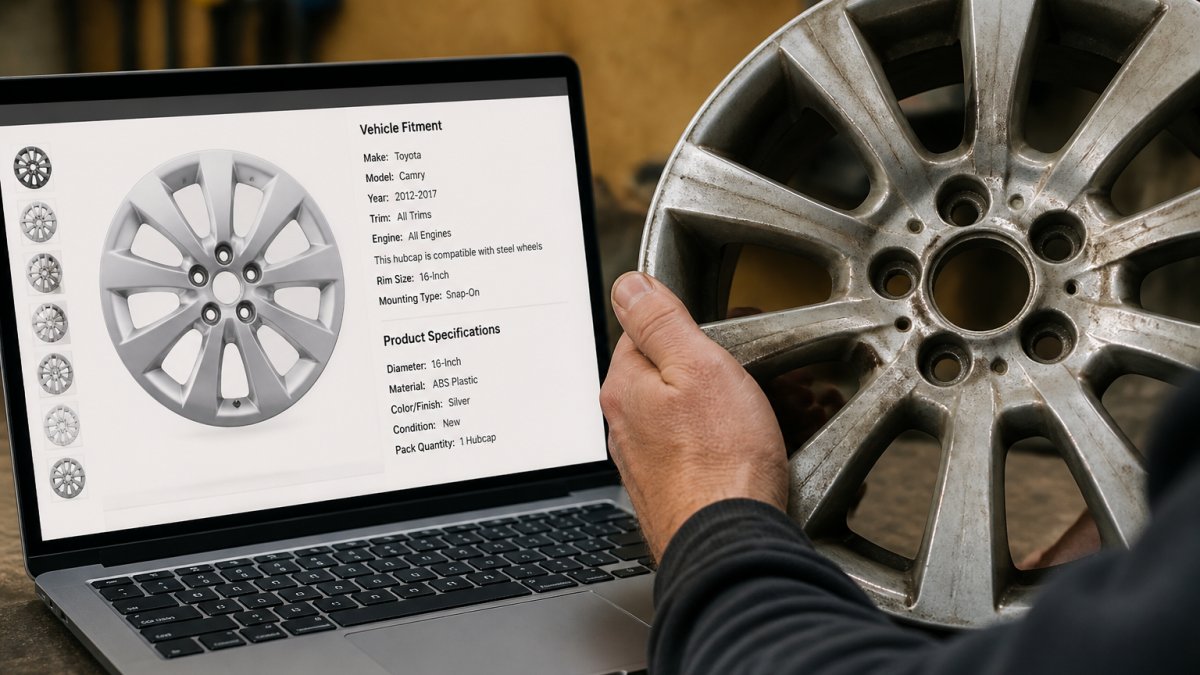
Online retailers have become the primary source for replacement hubcaps. These platforms stock original equipment manufacturer (OEM) parts and aftermarket options in one place. You can compare styles, prices, and availability without leaving home.
WheelCovers.Com stands out as a premier option for hubcap sourcing. With nearly 50 years of industry experience and over 1 million hubcaps in inventory, we provide nationwide shipping and a vast selection of original and custom wheel covers. Our website makes it easy to search by vehicle year, make, and model. You'll find exact matches or upgrade options that enhance your vehicle's appearance.
Specialized retailers focus entirely on wheel covers and hubcaps. This narrow focus means deeper inventory and more expertise than general auto parts stores. Staff can answer specific questions about fitment and compatibility. Many retailers offer detailed product photos, fitment guides, and customer reviews to help you make the right choice.
Benefits of online retailers include:
- Searchable inventory by vehicle specification
- Detailed product descriptions and photos
- Customer reviews and ratings
- Direct shipping to your location
- Easy return processes
- Competitive pricing
The convenience factor matters too. You browse at your own pace, compare options side by side, and order when ready. No pressure, no time constraints, no physical travel required.
Online retailers offer distinct advantages over traditional sourcing methods when shopping for replacement hubcaps.
| Advantage | Benefit | Details |
|---|---|---|
| Searchable inventory | Find parts by vehicle spec | Filter by year, make, model |
| Product information | Make informed decisions | Photos, descriptions, reviews |
| Shipping convenience | Parts delivered to home | Nationwide shipping available |
| Competitive pricing | Compare options easily | Side-by-side price comparison |
| Return processes | Risk-free purchasing | Easy returns if needed |
| Expert support | Get fitment answers | Staff familiar with compatibility |
Hubcap Fitment Guide: Matching Year, Make, and Model
Fitment accuracy determines whether your hubcap will fit securely and look right. A hubcap that doesn't fit creates safety issues and looks unprofessional. Proper fitment starts with exact vehicle identification.
Your vehicle's year matters because manufacturers change specifications frequently. A 2014 model may have different wheel sizing than a 2015, even for the same make and model. The year is your first filter when searching online.
Make and model are equally critical. Honda, Toyota, Ford, and Chevrolet each have unique specifications. Within each brand, different models use different wheel sizes. A sedan typically has different wheels than an SUV from the same manufacturer.
The fitment matching process:
- Enter your vehicle year in the search field
- Select your make from the dropdown menu
- Choose your model from the available options
- Filter by wheel size if needed
- Review compatible hubcap options
- Check product photos against your current wheels
- Read customer reviews mentioning your specific vehicle
Many online platforms now use vehicle identification number (VIN) lookup tools. You enter your VIN, and the system automatically identifies your exact specifications.
Don't rely on assumptions about fitment. A part that fits a similar vehicle may not work for yours. Always verify the year, make, and model match your vehicle exactly before ordering.
Hubcap Condition and Quality Checklist Before Ordering
Quality varies significantly among hubcaps. Some are original manufacturer parts. Others are aftermarket reproductions. New parts differ from refurbished ones. Understanding these differences helps you make an informed purchase.
Before ordering, evaluate the product listing carefully. Look for these quality indicators:
Condition assessment:
- New versus refurbished or used
- Any visible damage or defects in photos
- Finish quality (chrome, plastic, painted)
- Presence of all mounting clips and hardware
- Verification that the part is complete
Quality signals:
- Detailed product photography from multiple angles
- Clear description of condition
- Specifications matching your vehicle
- Customer reviews mentioning durability
- Warranty information if available
- Return policy details
Read customer reviews from people with your exact vehicle. Their feedback reveals real-world performance. Look for comments about fitment, durability, and appearance. Negative reviews often mention specific issues like poor paint quality or loose mounting.
Check whether the listing specifies new or refurbished condition. New parts cost more but arrive in original condition. Refurbished parts are cleaned and tested but may show minor wear. Used parts are cheapest but carry higher risk.
Verify that all necessary components are included. Some hubcaps require mounting clips or hardware. Confirm these are part of your order before purchasing.
Replacement Hubcaps by Year Make and Model: Finding Your Exact Match
Finding your exact match has become straightforward with modern online tools. Most retailers organize inventory by vehicle specification. You filter by year, make, and model, and the system displays compatible options.
This organizational approach transforms the search process. Instead of browsing thousands of parts, you see only what fits your vehicle. The narrowed selection makes decision-making faster and more confident.
Search workflow:
- Visit the retailer's website
- Select your vehicle year from the year dropdown
- Choose your make from the available options
- Pick your model from the filtered list
- Select your trim level if applicable
- Choose your wheel size if multiple options exist
- Browse the compatible hubcaps displayed
Many retailers display the exact part number alongside each option. This part number can be cross-referenced with your vehicle's documentation. Matching part numbers guarantees compatibility.
Photos are crucial at this stage. Compare the online product images with your current hubcap or wheel. Style, finish, and design should match your vehicle's appearance. Some vehicles have multiple hubcap options, so choose the style that matches your preference.
Customer reviews for your specific vehicle provide valuable insight. Someone who bought the same hubcap for the same vehicle can tell you if it fit perfectly or required adjustment. This real-world feedback reduces uncertainty.
Once you've found your match, verify the ordering details one final time. Confirm the year, make, model, and wheel size. Double-check that all necessary components are included. Then proceed with confidence.
Building a Parts-Sourcing Workflow for Vehicle Restoration
A systematic parts-sourcing workflow is what separates a restoration that finishes from one that stalls in the garage. The goal is to avoid the need to sift through junkyards for vehicle restoration by routing every part request through a repeatable process: identify, verify, source, order, receive, and log. Each step below names the actual channels and tools that make the workflow work.
Step 1: Build a master specification sheet
Create a single document (a spreadsheet works) that lists year, make, model, trim, engine, transmission, axle, wheel diameter, bolt pattern, and any RPO or build-sheet codes. Add a column for the OEM part number of every component you plan to replace. This sheet becomes the reference you check before every order, and it prevents the most common restoration error: buying a part that fits a similar vehicle but not yours.
Step 2: Classify each part by sourcing difficulty
Not every part needs the same process. Sort your list into three tiers:
- Readily available: consumables, fasteners, weatherstripping, and common wear items stocked by national auto parts chains and online retailers.
- Specialist-supplier items: model-specific components carried by marque specialists, restoration houses, and aftermarket manufacturers.
- Hard-to-find items: discontinued, low-volume, or date-coded parts that require owner clubs, swap meets, or parts-locator networks.
Tiering your list tells you where to spend research time and where to accept a longer lead time.
Step 3: Use the right channel for each tier
Specialist suppliers and restoration houses. Marque-specific suppliers stock parts that general retailers do not carry, and their catalogs often include interchange notes and superseded part numbers. Start here for anything tier two or three.
Online marketplaces and searchable inventories. Large marketplaces and dedicated parts-locator services let you search by part number across many sellers at once. This is the digital equivalent of walking a row of junkyards, without the drive.
Owner clubs and forums. Club classifieds, technical forums, and model-specific registries are where discontinued parts surface. Post a wanted ad with your part number and a photo; club members often have spares or know who does.
Swap meets and specialty shows. Regional swap meets concentrate hard-to-find parts in one place for a weekend. Bring your master sheet and part numbers, and arrive early.
Parts interchange databases. Interchange references show which years, models, and platforms share a component. A part that is scarce for your model may be common on a platform-mate, which widens your search without changing fitment.
Step 4: Verify before you order
For every candidate part, confirm the part number, model-year range, and any mid-year production changes. Ask the seller for additional photos, measurements, and the casting or stamping number. Confirm the return policy in writing. This step is covered in detail in the verification section below.
Step 5: Batch orders and manage freight
Group orders by supplier to consolidate shipping. For oversized items (sheet metal, glass, bumpers), confirm freight class and residential delivery surcharges before checkout. Track every order in your master sheet with order date, expected delivery, and status so you never double-order.
Step 6: Inspect and log on arrival
Open every shipment within the return window. Photograph the part, the packaging, and any damage. Log the part number and condition in your master sheet. A logged, photographed inventory prevents the classic restoration problem of buying the same part twice because you forgot you already had it.
This workflow replaces the junkyard walk with a documented process. You still source real parts, but you do it through named channels, verified part numbers, and a paper trail that keeps the project moving.
Verifying Fitment and Condition Before You Buy
Verification is the step that prevents a restoration budget from bleeding out on wrong parts. It happens in two phases: before you pay, and when the box arrives. Each phase has concrete checks you can run in minutes.
Phase 1: Pre-purchase verification
Confirm the part number. Every legitimate listing should show an OEM part number, a manufacturer number, or a casting number. Cross-reference that number against your master specification sheet and against an interchange reference. If the seller cannot provide a number, treat the listing as unverified.
Check the model-year range and production splits. Manufacturers change components mid-year. A part that fits an early-production vehicle may not fit a late-production one. Ask the seller which year and production range the part was pulled from, and compare it to your vehicle's build date on the door jamb label.
Request measurements. For body panels, trim, and wheels, ask for overall length, width, height, and mounting-hole spacing. Compare those numbers to the measurements of the part on your vehicle. Photos alone cannot confirm scale.
Ask targeted seller questions. A short list of questions separates serious sellers from casual ones:
- What is the exact part number stamped or cast on the part?
- Which year, make, model, and trim was it removed from?
- Are all mounting clips, brackets, and hardware included?
- Are there cracks, bends, rust-through, or previous repairs?
- Can you send additional photos of the mounting points and any damage?
- What is your return policy, and who pays return freight?
Read the return policy before you buy. Confirm the return window, whether returns are accepted for fitment reasons, and who covers return shipping. A listing without a stated return policy is a risk you should price into your decision.
Use fitment guides and VIN lookup tools. Many retailers publish fitment guides by year, make, and model, and some offer VIN-based lookup that narrows results to your exact build.
Phase 2: Post-delivery verification
Inspect the shipment before you install anything, and while the return window is still open:
- Match the part number on the part to the number on your order and your master sheet.
- Check for shipping damage, cracks, bends, crushed mounting points, or missing hardware.
- Dry-fit before final installation where possible, especially for trim and body parts.
- Photograph everything, the part, the packaging, the label, and any damage, before you contact the seller.
- Keep the box and packing materials until you are certain the part is correct.
If the part is wrong or damaged, contact the seller immediately, reference your photos, and follow the return process you confirmed before purchase. Catching a mismatch at delivery costs a return label; catching it after installation costs time, labor, and sometimes a damaged mounting surface.
Run these checks on every order, not just the expensive ones. The habit is what keeps a restoration on schedule and on budget.
Start Your Restoration Project With the Right Hubcaps
Beginning your vehicle restoration with proper hubcap sourcing sets the tone for the entire project. Getting this first step right builds momentum and confidence. You prove to yourself that online sourcing works, which encourages you to use the same approach for other restoration parts.
The right hubcaps enhance your vehicle's appearance immediately. They're visible, they're relatively affordable, and they install quickly. This creates an early win in your restoration timeline. That success motivates you to tackle more complex restoration work.
WheelCovers.Com makes this first step simple. With over 1 million hubcaps in inventory and nearly 50 years of industry experience, we specialize in helping vehicle owners find exact matches for their vehicles. Our nationwide shipping means your parts arrive quickly. Our wide selection of original and custom wheel covers ensures you'll find exactly what you need.
Start by visiting our website and searching for your vehicle. Enter your year, make, and model. Browse the compatible options. Read customer reviews from people with your exact vehicle. Then order with confidence, knowing you've found the right fit.
Frequently Asked Questions
How do I know which hubcap fits my specific vehicle before ordering?
Most online retailers allow you to filter by year, make, and model. Verify your vehicle's specifications in your owner's manual or on the driver's door jamb. Cross-reference the bolt pattern, diameter, and any trim details with the product listing. Many retailers display fitment charts and customer reviews confirming compatibility. Contact the seller directly if you're unsure, they can confirm fitment before you purchase.
What information do I need to identify the correct hubcap for my vehicle?
You'll need your vehicle's year, make, model, and trim level. Also note the wheel diameter (typically 14, 15, 16, or 17 inches), the number of lug holes, and the bolt pattern. Check your tire sidewall or owner's manual for wheel size. If your original hubcap is available, measure its diameter and count the lug holes. Some vehicles have multiple hubcap options depending on the trim package, so having your VIN or trim information helps narrow the search.
What should I check on a hubcap before buying it online?
Examine product photos for cracks, fading, or warping. Read customer reviews mentioning durability and fit accuracy. Verify the material (plastic, metal, or hybrid) matches your needs. Check whether the product is original equipment manufacturer (OEM) or aftermarket. Confirm the seller's return policy in case the hubcap doesn't fit or arrives damaged. Look for sellers offering detailed product descriptions and multiple photos from different angles.
Can I buy a single replacement hubcap, or do they come in sets?
Most online retailers sell individual hubcaps, allowing you to replace only the damaged or missing one. This is more affordable than buying a full set if you only need one. Some sellers offer discounts when purchasing multiple hubcaps for a complete wheel set. Check the product listing to confirm whether you're ordering one or multiple units. This flexibility makes online ordering ideal for targeted vehicle restoration without unnecessary expense.
Your vehicle restoration project starts with a single part. Make that part count by choosing correctly the first time. Proper sourcing, verification, and quality assessment eliminate the uncertainty that makes restoration frustrating. With the right hubcaps in hand, you're ready to move forward with your restoration goals.
