

Posted by Editorial Team on Oct 24, 2026
9 Steps to Get Insurance to Pay for OEM Wheel Replacement
Last Updated: October 25, 2026
Quick Summary
To get insurance pay OEM wheel replacement, request original parts in writing within 48 hours of reporting damage, provide a dealership quote confirming the OEM part number, and submit a shop supplement if your adjuster's estimate specifies aftermarket parts instead.
- Report wheel damage to your insurance company within 24 hours and request a claim number.
- Document damage with photos from multiple angles and note the date, time, and location.
- Contact your vehicle's dealership for a written OEM wheel quote with the part number before the adjuster finalizes the estimate.
- Ask your shop to submit a supplement with the OEM part number and fitment details if the initial estimate proposes aftermarket or recycled wheels.
- Appeal to a supervisor or file a formal complaint with your state insurance regulator if your adjuster denies the OEM request.
Table of Contents
- Why OEM Wheels Matter in Insurance Claims
- Understanding Insurance Coverage for Damaged Wheels
- Collision vs. Comprehensive: Which Covers Wheel Damage
- How to Request OEM Parts from Your Insurance Company
- Documenting Wheel Damage for Your Insurance Claim
- Getting an Accurate Wheel Replacement Estimate for Insurance
- Negotiating with Your Insurance Adjuster Over Parts
- How to Appeal an Auto Insurance Parts Decision
- Filing Your OEM Wheel Replacement Claim
- Frequently Asked Questions
Why OEM Wheels Matter in Insurance Claims
Original equipment manufacturer wheels are the parts your vehicle came with from the factory, and knowing how to get insurance pay OEM wheel replacements is essential when damage occurs. Your claim may cover replacement, but coverage depends on your policy and how you handle the process.
Insurers often default to aftermarket parts because they cost less upfront. But OEM wheels fit better, match your vehicle's original specifications, and hold their value, and many policyholders don't realize they can request them.
The difference comes down to your policy language and your willingness to negotiate. Some policies explicitly cover OEM parts; others require a written request.
Read your policy closely for terms like "OEM endorsement" or "original parts coverage." If it's unclear, contact your agent before filing a claim, this step alone can save you hundreds of dollars out of pocket.
Understanding Insurance Coverage for Damaged Wheels
Wheel damage falls under collision or comprehensive coverage, depending on how it happened. Your policy must include one to cover replacement.
Collision pays for damage from accidents, potholes, curbs, or another vehicle. Comprehensive handles weather, theft, or vandalism. Stolen or hail-damaged wheel: comprehensive. Hit something while driving: collision.
The catch is your deductible, typically $500 to $1,000, paid out of pocket before insurance covers the rest. If replacement costs $800 and your deductible is $500, insurance covers $300.
Some policies exclude wear items, and tires and wheels often fall into that category, a distinction that matters when deciding whether to file at all.
Collision vs. Comprehensive: Which Covers Wheel Damage
Collision coverage applies when your wheel is damaged by impact, a pothole, curb, road debris, or another vehicle. Collision is optional in most states, though lenders require it if you finance your vehicle.
Comprehensive coverage handles non-collision damage: theft, vandalism, weather events, and animal strikes. If someone steals your wheel or a tree falls on it, comprehensive pays. Comprehensive is also optional but often bundled with collision.
The practical difference: hit a pothole, file under collision; wheel stolen from your driveway, file under comprehensive.
Liability-only coverage pays for damage you cause to others, not your own vehicle, adding collision and comprehensive is the only way insurance covers your wheels.
How to Request OEM Parts from Your Insurance Company
Adjusters estimate repair costs using aftermarket parts by default. You must request OEM parts in writing to change this.
Contact your agent or claims adjuster immediately after damage occurs and request that insurance pay OEM wheel replacement costs, asking them to note this in your claim file.
Follow up with a written request via email or certified mail. Include:
- Your policy number
- Claim number
- A clear statement: "I request OEM wheel replacement for my claim."
- The vehicle's year, make, and model
- The specific wheel size and style
Send this to your insurance company's claims department and keep a copy for your records.
If your insurer asks why, explain that OEM wheels match your vehicle's original specifications, fit properly, and preserve value. If your policy includes an OEM endorsement guaranteeing original parts without negotiation, mention it in your request.
Timing matters. Make your OEM request early, before the adjuster finalizes the estimate. Once an estimate is approved, changing parts becomes harder.
Documenting Wheel Damage for Your Insurance Claim
Strong documentation is your best tool for supporting an OEM parts request.
Photograph the damage from multiple angles in daylight: close-ups and wide shots showing the wheel's position on the vehicle. If the wheel was stolen, photograph the empty space and any wheel-well damage.
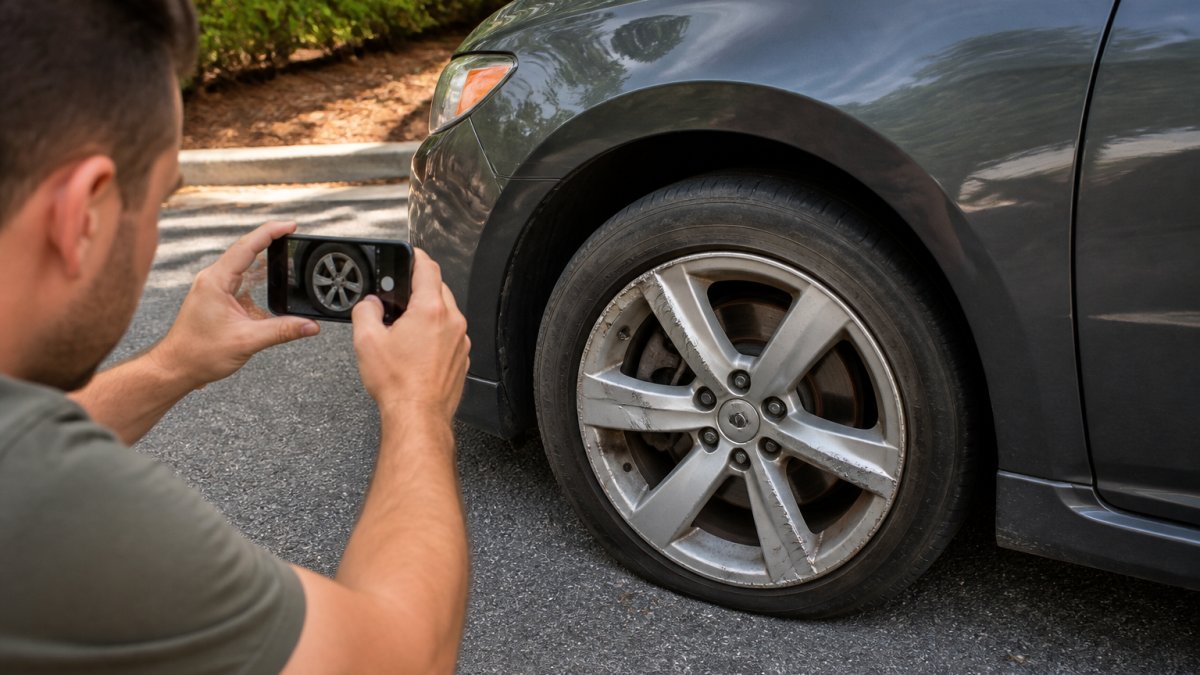
Keep all receipts and invoices. If a shop examined the wheel, get a written statement describing the damage and whether it's repairable or needs replacement.
Document the wheel's pre-damage condition if possible, old photos or service records prove it was functional before the incident. Write down how the damage happened: date, time, location, and cause. Get witness contact information if any were present.
Create a timeline: when damage occurred, when you reported it, when you contacted your insurer, and when you filed. Store all documentation in one folder, organized chronologically. Submit copies and never send originals.
Getting an Accurate Wheel Replacement Estimate for Insurance
An insurer's wheel estimate is a line-item document, and every line is a place where an OEM request can be won or lost. Most adjusters write it from a photo or an aftermarket/recycled parts database, so the first version usually specifies a non-OEM wheel. Read it line by line and respond in writing.
What a wheel estimate should itemize
A complete estimate for one damaged wheel typically includes:
- Wheel assembly, the part itself, with a part number and a designation of new OEM, recycled OEM, aftermarket, or reconditioned.
- Mount and balance, labor to transfer the tire and rebalance the assembly.
- Tire replacement or reuse, whether the tire is being carried over or replaced, and why.
- TPMS sensor, whether the sensor is being reused, replaced, or recalibrated; many wheels require a new sensor or a relearn procedure.
- Valve stem and hardware, lug nuts, center cap, and valve stem are frequently omitted from first drafts.
- Refinish or repair, if the estimate proposes repairing the wheel rather than replacing it, the method (welding, machining, straightening, refinishing) should be stated.
- Alignment or suspension inspection, an impact hard enough to bend a wheel often warrants a check.
- Taxes and shop fees, stated separately so you can compare like for like.
If any line is missing, ask the adjuster to add it before you discuss parts. An estimate that omits mount and balance or a TPMS sensor understates the true cost.
How to read the parts designation
Look for the words the estimator used next to the wheel line. Insurers commonly use shorthand:
- OEM / OE, original equipment, new.
- Recycled / LKQ, a used original wheel from a salvage yard; still an original part, but with unknown history.
- Aftermarket / A/M, a non-original wheel, often a replica.
- Reconditioned, a damaged original wheel that has been repaired and refinished.
Each designation carries different implications for fit, finish match, and warranty. A recycled OEM wheel may satisfy an OEM request in the insurer's view even though it is not new, clarify which you want.
Getting your own OEM quote
Contact the parts department at a franchised dealer for your vehicle's make and ask for a written quote on the exact wheel for your VIN. Request:
- The OEM part number and any superseded part numbers.
- The list price and the dealer's selling price.
- Whether the wheel is stocked or special order.
- Any core charge or freight.
Ask the dealer to confirm in writing that the part number matches your vehicle's original equipment. That sentence is the single most useful document in an OEM dispute, because it converts your preference into a fitment fact.
The shop supplement: the tool most policyholders never use
If your chosen repair shop disagrees with the insurer's estimate, the shop can submit a supplement, a revised estimate with additional or different line items, supported by photos and part numbers. Supplements are routine in collision repair; they are how shops correct an estimate written from photos before teardown. You can ask your shop to supplement specifically for:
- An OEM wheel in place of an aftermarket or recycled wheel, with the dealer quote attached.
- Mount, balance, TPMS, and hardware lines the first estimate omitted.
- A replacement recommendation instead of a repair recommendation, with the shop's written reasoning.
A supplement carries more weight than a policyholder's email because it comes from a licensed repairer with the vehicle in front of them. Ask the shop to note on the supplement why the aftermarket or repaired option is inadequate, fitment, finish match, structural concerns, or manufacturer requirements.
Ask the shop to photograph the damaged wheel next to the proposed replacement, and to include the OEM part number on the supplement. Adjusters approve supplements faster when the documentation answers the question before they ask it.
Comparing estimates fairly
When you have both documents, compare them line by line rather than by total. The relevant question is not 'which total is lower' but 'what is the difference in the wheel line, and is that difference justified by the OEM part?' A common pattern is that the OEM wheel line is higher but the labor, mount, balance, and tax lines are identical, which isolates the dispute to a single number you can negotiate.
When the estimate proposes repair instead of replacement
Insurers often prefer refinishing or straightening a wheel because it is cheaper than replacement. Whether that is appropriate depends on the damage: cosmetic curb rash and minor bends are commonly repaired, while cracks, severe bends, and damage near the bead seat or spoke roots raise structural questions. Ask the shop for a written opinion on repairability and have it added to the supplement. If the shop will not certify the wheel as safe after repair, say so in writing to the adjuster, that shifts the conversation from cost to liability.
Keep the paper trail
Save the original estimate, your dealer quote, the supplement, and every email in one folder. Note the date each document was sent and the name of the person you spoke with. If the dispute later goes to an appraisal or a regulator, this file is your case.
Negotiating with Your Insurance Adjuster Over Parts
Negotiation starts with understanding your adjuster's constraints. Adjusters work within company guidelines and policy language. Your job is to show that OEM parts fit within those guidelines.
Begin by reviewing your policy again. If it includes an OEM endorsement or original parts coverage, cite this directly. Tell your adjuster: "My policy covers OEM parts.
If your policy doesn't explicitly cover OEM parts, focus on fit and safety. Explain that the aftermarket wheel in the estimate doesn't match your vehicle's original specifications.
Request a meeting or call with your adjuster to discuss the estimate. Email discussions can feel adversarial. A conversation allows you to explain your position more persuasively.
Bring documentation to this conversation. Have your OEM quote from the dealership ready. Show the difference in price. Offer to pay a portion of the difference yourself if necessary.
Stay calm and professional. Adjusters respond better to respectful requests than demands. Frame your request as solving a problem together: "Let's make sure this wheel fits your vehicle correctly."
If your adjuster refuses to budge, ask to speak with a supervisor. Most insurance companies have a process for appealing adjuster decisions. Use it.
How to Appeal an Auto Insurance Parts Decision
An OEM parts dispute is rarely a single yes-or-no decision. It usually moves through a ladder: adjuster, supervisor, formal appeal, appraisal, and, if all else fails, the state insurance regulator. Knowing which rung you are on, and what each one can actually deliver, keeps you from wasting weeks on the wrong step.
First, identify what was actually denied
Insurers deny OEM requests in two very different ways, and the appeal path differs:
- A coverage position, the policy does not owe OEM parts for your loss. This is a contract interpretation. Your appeal argues policy language: an OEM endorsement, an original parts provision, or ambiguity that should be read in your favor.
- A claim-handling decision, the policy might owe OEM parts, but the adjuster wrote the estimate with aftermarket or recycled parts anyway. This is a negotiation and documentation problem, not a contract problem. Your appeal argues fitment, safety, and the shop supplement.
Ask the adjuster, in writing, which one it is: 'Is the company denying that my policy covers OEM parts, or is this an estimate decision?' The answer tells you which argument to make and which documents to attach.
Step 1: The written appeal to the company
Send a formal appeal to the claims department, not to the individual adjuster's email, and send it by a method that produces a delivery record. Include:
- Policy number and claim number.
- The specific estimate line you dispute, quoted exactly.
- The policy language you rely on, quoted with the section heading.
- The dealer quote with the OEM part number and fitment confirmation.
- The shop supplement and photos.
- A clear request: approval of the OEM wheel, or a written explanation of the denial.
Ask for the response in writing. A phone approval that is never documented is difficult to enforce later.
Step 2: Supervisor and the company's internal review
If the adjuster will not move, ask for the claims supervisor and then for the company's internal appeals or customer relations unit. Many insurers have a formal review step that sits above the adjuster and below the regulator. Ask what the company's own complaint process is and how long each stage takes. Note the dates.
Step 3: The appraisal clause
Many auto policies contain an appraisal clause, a dispute-resolution provision that applies when you and the insurer disagree on the amount of the loss. The mechanics vary by policy, but the common pattern is:
- You demand appraisal in writing.
- Each side selects a competent appraiser.
- The two appraisers select an umpire.
- Each appraiser states an amount; if they agree, that is the binding amount. If they disagree, the umpire decides between them.
Appraisal is typically about the amount of the loss, not about coverage. That distinction matters: if the insurer's position is that the policy simply does not owe OEM parts, appraisal may not resolve it. If the dispute is over what the repair should cost, including whether an OEM wheel is the appropriate part, appraisal is often the most direct route. Read your policy's appraisal clause before invoking it, and put the demand in writing.
Appraisal can cost money, appraisers and umpires are usually paid by the parties, and the policy may allocate fees. Ask about fees before you demand appraisal, and weigh them against the difference between the OEM and aftermarket wheel line.
Step 4: The state insurance regulator
Every state has an insurance department that accepts consumer complaints. Filing is generally free. What a regulator can do is investigate whether the insurer followed state claims-handling rules and its own policy; what a regulator generally cannot do is order the insurer to buy you a specific part. Set expectations accordingly, the complaint is a pressure point and a documentation exercise, not a guarantee.
When you file, include the same package you sent in the appeal, plus a short timeline: date of loss, date reported, date of estimate, date of OEM request, date of denial, and dates of each follow-up. State regulators respond to organized files.
Step 5: Other routes
- Small claims court, available in every state, with dollar limits that vary widely. Filing fees are modest, but the amount in dispute for a single wheel is often close to the limit, and the time cost is real. Treat it as a last resort.
- Consumer protection or attorney general offices, some states route insurance complaints through a separate consumer affairs division. Ask the insurance department which office handles your issue.
- A consumer attorney, worth a consultation if the dispute involves a pattern of conduct rather than a single wheel.
Document every rung
For each step, record the date, the person you spoke with, what they said, and what you sent. Keep copies of letters and emails. If the dispute reaches appraisal or a regulator, the party with the cleaner timeline is usually the party whose version of events is accepted.
The appeal is not one letter, it is a sequence. Identify whether the denial is about coverage or about the estimate, argue the right question, use the shop supplement and dealer quote as your evidence, and escalate in order: company appeal, supervisor, appraisal clause, regulator.
Filing Your OEM Wheel Replacement Claim
The claims process begins the moment damage occurs. How you handle these first steps determines whether you'll get OEM parts coverage.
Step 1: Report the damage immediately. Contact your insurance company within 24 hours of discovering damage.
Step 2: Document everything. Take photos and videos of the damage from multiple angles. Write down the date, time, location, and circumstances.
Step 4: Get your own estimate. Contact your vehicle's dealership and request a quote for an OEM wheel.
Step 5: Review the insurance estimate. When your adjuster sends an estimate, check whether it specifies aftermarket or OEM parts.
Step 6: Communicate your concerns. If the estimate uses aftermarket parts, email your adjuster explaining why OEM parts are necessary.
Step 7: Follow up. If you don't hear back within one week, call your adjuster directly.
Step 8: Approve or appeal. If the estimate approves OEM parts, you can proceed with repairs.
Throughout this process, keep records of every interaction. Save emails, note phone calls with dates and names, and maintain copies of all documents.
Getting insurance to pay OEM wheel replacement requires knowing your policy, documenting damage thoroughly, and negotiating confidently with your adjuster. At WheelCovers.Com, we help vehicle owners understand their wheel options and find quality replacements.
Follow these nine steps in order to request and secure OEM wheel replacement coverage from your insurance company.
| Step | Action | Timing |
|---|---|---|
| 1 | Report damage to insurance company | Within 24 hours |
| 2 | Document damage with photos and notes | Immediately after reporting |
| 3 | Request OEM parts in writing | Within 48 hours of reporting |
| 4 | Get dealership OEM wheel quote | Before adjuster finalizes estimate |
| 5 | Review insurance estimate for parts designation | Upon receipt from adjuster |
| 6 | Email adjuster with concerns and documentation | If estimate specifies aftermarket |
| 7 | Follow up if no response | Within one week |
| 8 | Approve estimate or submit formal appeal | Based on adjuster response |
Frequently Asked Questions
Does collision coverage pay for wheel damage?
Collision coverage typically covers wheel damage from accidents, collisions, and impact events. Comprehensive coverage handles non-collision damage like theft or weather. Your policy determines which applies to your situation. Check your declarations page to confirm whether collision or comprehensive is active, and review your deductible, you'll pay that amount out of pocket before the insurer covers the rest. Contact your insurance agent to clarify which coverage type applies to your specific damage.
How do I request OEM parts from insurance?
When filing your claim, explicitly tell your insurance agent or adjuster that you want OEM (original equipment manufacturer) wheels, not aftermarket replacements. Provide the vehicle's original specifications and documentation that shows the wheels are factory-installed. Submit a written request with your claim, stating that OEM parts match your vehicle's safety and fitment standards. If the adjuster initially denies OEM coverage, ask for the specific policy language that excludes it. Many policies allow OEM parts; the key is requesting them clearly and early in the claims process.
Can I appeal an insurance decision about replacement parts?
Yes. If your insurer denies OEM wheel coverage or approves only aftermarket parts, you can appeal. Request a formal review in writing, explaining why OEM wheels are necessary (safety, fitment, warranty). Include documentation from the manufacturer or your mechanic supporting the OEM requirement. If the appeal is denied, you can file a complaint with your state's insurance commissioner. Some states require insurers to justify parts decisions; your state's insurance administration website lists complaint procedures and timelines.
What evidence helps support an OEM wheel replacement request?
Gather your vehicle's original purchase documents, manufacturer specifications showing factory wheel size and type, and photos of the damaged wheel. Obtain a repair estimate from a certified repair shop that specifies OEM parts and explains why they're necessary for safety and fitment. Include any warranty information tied to OEM components. Your insurance agent or broker can help frame this evidence. The stronger your documentation, the harder it is for the adjuster to deny your request without clear policy language supporting aftermarket-only coverage.
