

Posted by Editorial Team on Oct 15, 2026
Hubcap Replacement Cost: What You'll Pay in 2026
Table of Contents
- Hubcap Replacement Cost: A Full Price Breakdown
- Single Hubcap Replacement vs. Buying a Set of Four
- OEM Hubcaps vs. Aftermarket and Generic Replacements
- Wheel Cover Size Guide: How to Find the Right Fit
- Hubcap Installation: DIY Difficulty and What a Shop Charges
- Materials and Durability: ABS Plastic, Steel, and Alloy Wheels
- Repair or Replace? When It Makes Sense to Fix a Damaged Cover
- How to Save on Hubcap Replacement Cost
- Conclusion
- Frequently Asked Questions
Last Updated: October 15, 2026
Hubcap Replacement Cost: A Full Price Breakdown
Hubcap replacement cost is the total you pay to put a missing or damaged wheel cover back on your car, and it depends on four things: whether you buy one or four, whether the cover is OEM or aftermarket, the wheel diameter, and who installs it. At WheelCovers.Com, we've supplied original and custom wheel accessories for nearly 50 years, so we've watched this market shift from salvage-yard scavenging to ordering a direct-fit cover online. The global automotive wheel hub cap market was valued at USD 2.14 billion in 2025 and is projected to reach USD 3.47 billion by 2033, according to DataHorizzon Research's automotive wheel hub cap market report. That growth tells you something simple: more drivers are replacing covers instead of living with bare steel wheels.
Here's the part most guides get wrong. They quote a single "average price" as if every hubcap costs the same. It doesn't. A basic 15-inch aftermarket cover and a dealer-sourced OEM cover for a late-model SUV are not in the same category, and treating them as one number is how people overpay.
Below, we break down what actually drives the bill, where you can save, and how to avoid buying the wrong size twice.
| Cost Factor | What It Changes | Typical Impact |
|---|---|---|
| Quantity | One cover vs. a set of four | Set pricing usually lowers the per-cover rate |
| Source | OEM vs. aftermarket vs. refurbished | OEM is highest, generic is lowest |
| Wheel diameter | 15-inch vs. 16-inch vs. larger | Larger covers cost more |
| Installation | DIY vs. shop | DIY is free, shops charge labor |
| Material | ABS plastic vs. metal | Metal and chrome finishes cost more |
Single Hubcap Replacement vs. Buying a Set of Four
Single hubcap replacement is the right call when one cover is missing and the other three are in good shape. Buying a set of four makes more sense when two or more are damaged, cracked, or faded, or when you want a consistent finish across the car.
The reason this decision matters more than most buyers expect is that the sticker price on one cover is not your total. Your real total is the cover plus shipping plus tax, and on a single-cover order those last two items are spread across one unit instead of four. A common pattern is a flat shipping charge that applies whether you order one cover or four, which means the per-cover delivered cost on a single order runs noticeably higher than on a set. Tax follows the same logic: it is a percentage of the order, so it scales with quantity rather than punishing it.
Here is how to build your own comparison before you buy:
- Find the per-cover price for the exact fitment you need.
- Note the shipping charge for a one-cover order and for a four-cover order.
- Add your state and local sales tax rate to each subtotal.
- Divide each total by the number of covers to get your true cost per wheel.
That last step is the one people skip, and it is the one that changes the answer. A set that looks more expensive at the sticker level often wins on cost per wheel once shipping and tax are spread across four units.
A few practical points:
- Match the style exactly if you're replacing one, since finishes fade at different rates.
- Check the retention ring and clips on your surviving covers while you're at it.
- Confirm the wheel diameter before anything else.
OEM Hubcaps vs. Aftermarket and Generic Replacements
OEM hubcaps are covers made to the original equipment manufacturer's specification for your specific model. Aftermarket and generic replacements are made by third parties to fit the same wheel, often at a lower price and in a wider range of styles. Refurbished covers are original parts that have been cleaned, reconditioned, and resold.
The trade-off is authenticity versus cost, but the useful way to see it is as a ranking. On cost, generic sits at the bottom, aftermarket sits in the middle, refurbished sits above aftermarket because you are paying for an original part, and OEM sits at the top. On fit and appearance, that order roughly reverses: OEM matches the factory finish, logo, and profile exactly, refurbished matches the original shape but may show minor wear, aftermarket is close but the finish can differ slightly, and generic is the plainest.
| Option | Relative Cost | Fit and Appearance | Availability | Best For |
|---|---|---|---|---|
| OEM replacement | Highest | Exact factory match | Limited on older models | Restoring a factory look, matching one cover on a factory set |
| Refurbished original | Above aftermarket | Original shape, minor wear possible | Stock varies by style | Hard-to-find original styles on a budget |
| Aftermarket | Middle | Close fit, finish may differ slightly | Broad, many styles | Style upgrades, budget replacement |
| Generic replacement | Lowest | Basic fit, plainest finish | Broadest on common sizes | Basic coverage on older vehicles |
Two factors push OEM and refurbished prices up beyond the part itself. The first is scarcity: a cover for a discontinued model or an uncommon trim is simply harder to find, and limited supply raises what sellers can charge. The second is complexity: covers with a specific spoke pattern, a branded center logo, or a two-tone finish cost more to produce and to source than a plain cover in a common size. If your vehicle is common and your cover is a simple design, generic and aftermarket options will usually cover you. If your vehicle is uncommon or you are matching an existing factory set, OEM or refurbished is the safer route.
What most buyers miss is that "OEM-style" and "OEM" are not the same claim. An OEM-style cover copies the look. An OEM cover is the genuine part. Ask which one you're getting before you order, especially on a lease or a car you plan to resell.
Wheel Cover Size Guide: How to Find the Right Fit
A wheel cover size guide starts with one measurement: your wheel diameter in inches, which is the number stamped on the tire sidewall after the "R" (for example, R16 means a 16-inch wheel). Hubcaps are sold by that diameter, not by the tire's overall height.
Here's how to get it right the first time:
- Read the tire sidewall for the wheel diameter, such as 15, 16, 17, or 18 inches.
- Confirm your wheel type, since steel wheels and alloy wheels take different covers.
- Note the number of clips or the retention ring style your cover uses.
- Match the finish and spoke pattern to your existing set if replacing one.
- Check the listing's fitment notes for your model year and trim.
A 16-inch cover will not fit a 15-inch wheel, and no amount of force changes that. This is why we tell customers to measure before they browse, not after. Measuring takes two minutes and prevents a return.
Hubcap Installation: DIY Difficulty and What a Shop Charges
Hubcap installation is a DIY job for most drivers. Snap-on covers press onto the steel wheel and seat when the clips or retention ring engage. The whole process takes a few minutes per wheel with no special tools.
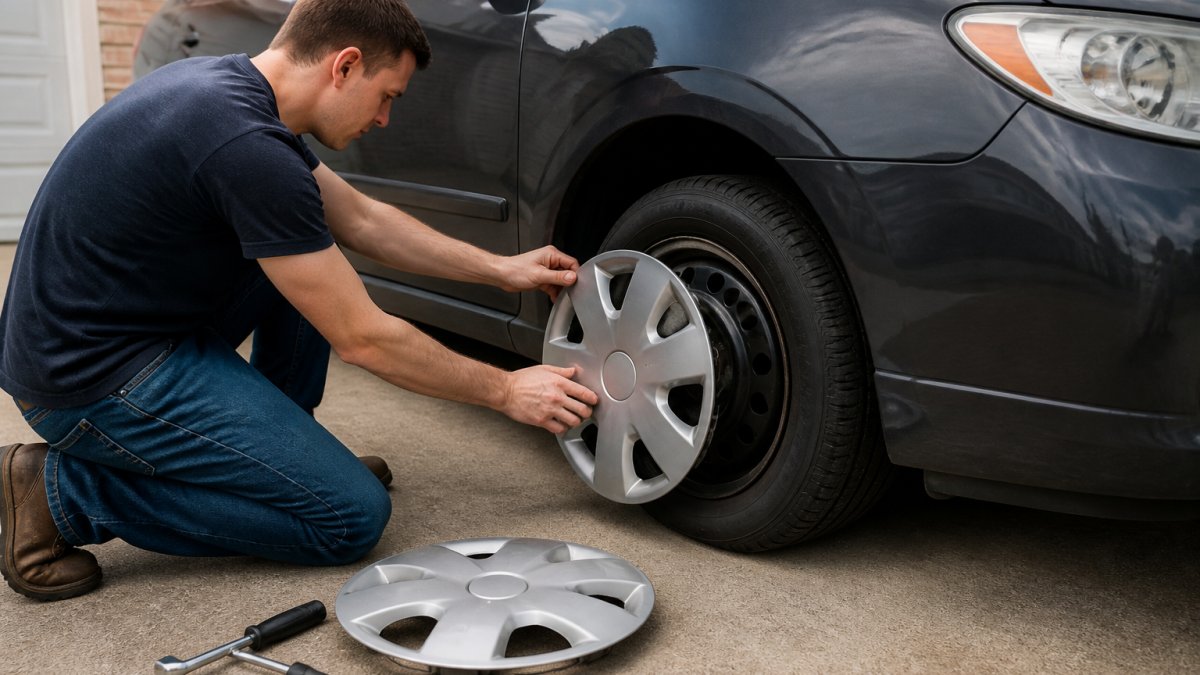
Line up the valve stem cutout first, then work around the rim pressing firmly until you hear or feel each clip seat. If a cover won't seat, stop. Forcing it usually means the size is wrong or a clip is bent.
If you'd rather not do it yourself, a tire shop or mechanic can handle it, and labor for a job this quick is minimal. Many shops charge a small flat fee per wheel, and some mount them free when you're already there for tire service. Call ahead for the shop's rate, since labor pricing varies by location and we don't quote it for you.
Materials and Durability: ABS Plastic, Steel, and Alloy Wheels
ABS plastic is the most common hubcap material because it's light, resists dents, and holds a molded finish well. Chrome and metal finishes look sharper but show scratches and curb rash more readily.
Durability depends as much on the wheel underneath as the cover itself. Steel wheels take snap-on covers with clips or a retention ring. Alloy wheels usually use a center cap that covers only the hub, not the full wheel face, so the part you're buying is different.
- ABS plastic: light, affordable, good for daily driving.
- Chrome and polished finishes: sharp look, more care needed to stay clean.
- Center caps: for alloy wheels, smaller and model-specific.
Match the material to how you drive. If you park on the street and clip curbs, ABS plastic forgives more than a polished metal cover will.
Repair or Replace? When It Makes Sense to Fix a Damaged Cover
Repair makes sense only for minor cosmetic damage on a cover that's otherwise sound. Replace the cover when clips are broken, the retention ring is bent, or the plastic has cracked through.
Cracked ABS plastic doesn't glue back into a reliable cover. It flexes, and the repair fails the first time you hit a pothole. Bent clips are the same story: once the tension is gone, the cover won't stay seated at speed. A cover that comes off while driving is a hazard to you and everyone behind you.
- Small scuff or scratch: touch up or leave it.
- Cracked plastic: replace.
- Broken or missing clips: replace.
- Bent retention ring: replace.
- Faded finish across all four: price a set.
If you're weighing a repair against a replacement, factor in the risk. A cover that fails at highway speed isn't worth saving.
How to Save on Hubcap Replacement Cost
You can lower hubcap replacement cost without settling for a poor fit. The biggest savings come from buying the right part once, then avoiding the costs that follow a wrong order.
- Measure your wheel diameter before ordering, not after.
- Compare single-cover and four-pack pricing for your model.
- Choose aftermarket or OEM-style when a factory-exact match isn't required.
- Check fitment notes for your model year and trim.
- Order online to skip the time and fuel spent searching salvage yards.
Ordering online also widens your selection. Local parts stores stock common sizes, but older and less common vehicles are often special-order only. A supplier with deep inventory can ship the exact cover to your door.
Conclusion
Finding the right cover at a fair price comes down to measuring correctly and buying from a supplier who actually stocks your fitment. WheelCovers.Com has been family owned since 1979, carries an inventory of over 1 million hubcaps and wheel covers, and ships nationwide, so you can search by vehicle instead of sifting through junkyards. Our online ordering makes it easy to confirm the size and style before you buy, and our selection covers original and custom options for cars, trucks, and SUVs. Get started with WheelCovers.Com and put the right cover back on your wheel the first time.
Frequently Asked Questions
How much does a wheel cover cost?
Hubcap replacement cost depends on the type you choose. Pricing varies by wheel diameter, material, and finish. Check WheelCovers.com for current pricing on your specific vehicle.
Can you buy one hubcap?
Yes. Single hubcap replacement is common when only one cover is lost or damaged. Match the size, style, and finish to your existing covers so the replacement blends in.
Are OEM hubcaps more expensive than aftermarket ones?
OEM hubcaps replicate factory tooling and finishes exactly. Aftermarket and generic replacements may differ slightly in color, weight, or clip tension. If matching the original look matters, OEM-style is often preferred. If budget drives the decision, aftermarket covers fit the same wheels.
How do I find the right hubcap size for my car?
Measure the wheel rim diameter in inches, not the tire. A 15-inch wheel takes a 15-inch hubcap. Check the sidewall marking (e.g., P215/60R16 means a 16-inch wheel) or measure across the rim's bead seat. Confirm clip count and retention ring style before ordering to avoid returns.