

Posted by Editorial Team on Oct 23, 2026
How to Identify Correct Lug Nut Pattern for Hubcap Fitment
Last Updated: October 23, 2026
Quick Summary
To identify how to identify correct lug nut pattern for hubcap fitment, measure the distance between lug hole centers on your wheel, convert to millimeters, and match against standard patterns like 4x100, 5x114.3, or 6x139.7. Verify your result in your vehicle's owner's manual, which lists the exact bolt pattern specification.
- For 4-lug wheels, measure center-to-center distance between opposite holes directly across from each other.
- For 5-lug wheels, measure between holes two positions apart and multiply by the conversion factor 1.7013.
- Common 5-lug patterns include 5x100, 5x114.3, 5x120, and 5x127; common 4-lug patterns are 4x100, 4x114.3, and 4x130.
- A hubcap designed for one bolt pattern will not fit another pattern even if lug counts match, because clip spacing depends on PCD.
- Check your owner's manual first, it provides the official bolt pattern specification without requiring measurement.
Table of Contents
- What Is a Bolt Pattern and Why It Matters for Hubcap Fitment
- How to Measure a 4 Lug Bolt Pattern
- How to Measure a 5 Lug Bolt Pattern
- Understanding PCD and Pitch Circle Diameter
- Wheel Cover Size by Tire Size and Bolt Pattern
- Wheel Cover Clips and Retention System
- Checking Your Vehicle's Owner's Manual
- Common Mistakes When Measuring Lug Nut Patterns
- Tools and Resources for Accurate Measurement
- Frequently Asked Questions
What Is a Bolt Pattern and Why It Matters for Hubcap Fitment
A bolt pattern is the arrangement of lug holes on your wheel hub. It tells you how many studs your wheel has and how far apart they are. Knowing how to identify correct lug nut pattern for hubcap fitment is critical, install the wrong size and your wheel cover won't stay secure.
Your vehicle's bolt pattern is determined by the manufacturer. It's part of your wheel's fundamental design. When you buy a hubcap, it must match your wheel's bolt pattern exactly. A hubcap designed for a 5-lug pattern won't work on a 4-lug wheel, no matter how close the diameter seems.
Understanding Lug Nuts and Studs
Lug nuts are the fasteners that hold your wheel to the hub. Studs are the threaded bolts that stick out from your wheel hub. The studs pass through the lug holes in your wheel, and the lug nuts thread onto those studs to secure everything.
The number of studs determines your lug count. Most passenger vehicles have 4, 5, or 6 studs. Some trucks have 8. Older vehicles might have 3 or 7. Each configuration requires a different hubcap.
How Bolt Pattern Affects Hubcap Compatibility
Your hubcap clips onto the lug holes. The clips must align perfectly with those holes. If the spacing is off, the clips won't catch properly. Your wheel cover will either fall off while driving or sit crooked on the wheel.
But you need to know your pattern first. That's what this guide covers.
How to Measure a 4 Lug Bolt Pattern
A 4-lug bolt pattern is straightforward to measure. You measure the distance between the center of one lug hole and the center of the opposite lug hole.
Using a Tape Measure or Caliper
Grab a tape measure or caliper. You need something that measures to the nearest 1/16 of an inch for accuracy.
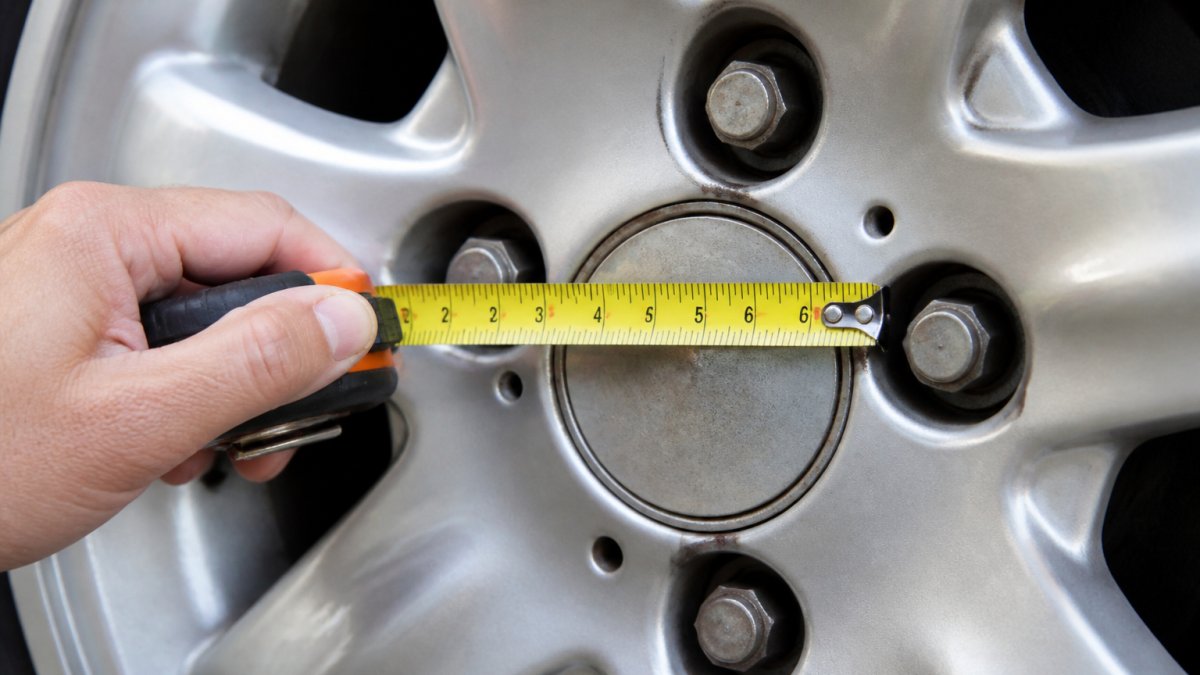
Find two lug holes directly across from each other. Place your measuring tool so it touches the center of one hole. Stretch it across to the center of the opposite hole. Write down the measurement.
This center-to-center distance is your bolt pattern. Common 4-lug patterns are 4x100mm, 4x114.3mm, and 4x130mm. The first number is the lug count. The second is the diameter in millimeters.
Calculating Center-to-Center Distance
Once you have your measurement, convert it to millimeters if needed. One inch equals 25.4mm. If your tape measure shows 3.94 inches, that's approximately 100mm.
Round to the nearest common size. Most 4-lug patterns fall into standard increments. If your measurement is close to 100mm, it's likely 4x100. If it's closer to 114.3mm, that's your pattern.
How to Measure a 5 Lug Bolt Pattern
A 5-lug bolt pattern is the most common passenger-car configuration in the United States, and it is also the one people get wrong most often. You cannot measure straight across because no two holes sit directly opposite each other. Every measurement you take is a chord of the pitch circle, not the diameter, so it has to be converted.
The Odd-Lug Measurement Method
With 5 studs arranged in a circle, the practical approach is to measure from the center of one lug hole to the center of the hole two positions away (skip one hole in between). That gives you a chord length you can convert to PCD.
Step by step:
- Clean the wheel face so the lug hole centers are visible.
- Pick any lug hole as your starting point.
- Count two holes clockwise (hole 1 to hole 3).
- Measure center-to-center between those two holes with a tape measure or caliper.
- Record the measurement in millimeters (multiply inches by 25.4).
- Apply the 5-lug conversion factor below.
Converting Measurements to PCD
For a 5-lug wheel, the chord between holes two positions apart relates to PCD by a fixed factor of about 1.7013 (some references round to 1.701). Multiply your chord measurement by that factor to get PCD.
Worked example: a chord of 67.1mm between holes two apart gives 67.1 × 1.7013 ≈ 114.2mm, which rounds to the standard 5x114.3 pattern (often written 5x4.5 in inches). A chord of 70.5mm gives ≈ 120.0mm, pointing to 5x120. A chord of 74.7mm gives ≈ 127.1mm, the 5x127 (5x5) pattern common on larger SUVs and trucks.
Common 5-lug patterns you will encounter: 5x100, 5x10⁵, 5x110, 5x112, 5x114.3 (5x4.5), 5x115, 5x120, 5x120.65 (5x4.75), 5x127 (5x5), and 5x139.7 (5x5.5). The first number is always the lug count; the second is PCD in millimeters.
Why the 5-Lug Pattern Matters for Hubcap Fitment
Hubcaps for 5-lug wheels use retention clips that engage the lug holes or the wheel rim. A cover built for 5x114.3 will not seat on a 5x120 wheel even though both have five lugs, because the clip spacing is set to the pitch circle. This is the distinction most fitment guides skip: the lug pattern does not hold the hubcap on by itself, but it dictates where the clips land, and clips that land in the wrong place will not snap in.
Understanding PCD and Pitch Circle Diameter
PCD stands for Pitch Circle Diameter. It's the diameter of an imaginary circle that passes through the center of all your lug holes.
PCD is the universal way to describe bolt patterns. It's measured in millimeters. When you see a wheel spec like "5x114.3," the 114.3 is the PCD.
PCD matters because it determines which hubcaps fit your wheel. A hubcap designed for 5x114.3 won't work on 5x120.65, even though both have 5 lugs. The spacing is different.
Knowing your PCD takes the guesswork out of buying a wheel cover. You can search by PCD and find exact matches.
Wheel Cover Size by Tire Size and Bolt Pattern
Your hubcap diameter depends on two things: your tire size and your bolt pattern. These work together.
Matching Hubcap Diameter to Your Wheel
Hubcap diameter is measured in inches. Common sizes are 14, 15, 16, and 17 inches. This corresponds to your wheel diameter, which is tied to your tire size.
A 14-inch wheel takes a 14-inch hubcap. A 16-inch wheel takes a 16-inch hubcap. The bolt pattern must also match.
So when you're shopping, you need three pieces of information:
- Wheel diameter (from your tire size)
- Lug count
- PCD (or bolt pattern)
Offset and Backspacing Considerations
Offset is how far your wheel sits from the hub. Backspacing is the distance from the wheel's mounting surface to the back edge of the rim.
These affect how your wheel sits on your vehicle. They don't directly impact hubcap fitment, but they matter for overall wheel assembly. A hubcap that fits the bolt pattern will work regardless of offset or backspacing.
However, extreme offsets can make a hubcap look odd. It might sit too far out or too far in. Most OEM hubcaps are designed for standard offset ranges. If your wheels have unusual offset, mention it when shopping.
Wheel Cover Clips and Retention System
Your hubcap stays on through a clip system. These clips engage with the lug holes and the wheel rim. Understanding how they work helps you install a cover correctly.
Hub-Centric vs. Lug-Centric Retention
Hub-centric hubcaps center on the wheel hub itself. They rely on the hub bore for alignment. Lug-centric hubcaps center on the lug holes. The clips grab the lug holes to hold the cover in place.
Most aftermarket hubcaps are lug-centric. This is simpler and works across more vehicles. The clips snap into the lug holes. Once engaged, they hold the cover tight.
Hub-centric covers are typically OEM (original equipment manufacturer) pieces. They're more precise but less versatile. They fit specific vehicles only.
Ensuring Proper Fastener Engagement
When you install a hubcap, the clips must fully engage with the lug holes. Push the cover straight onto the wheel. You should feel the clips snap into place.
If the cover doesn't snap on, stop. Don't force it. The bolt pattern might be wrong. Check your measurement and verify the pattern before proceeding.
Proper engagement is critical. A loose hubcap can vibrate and fall off. A correctly fitted cover stays secure even on rough roads.
Checking Your Vehicle's Owner's Manual
Your owner's manual contains your bolt pattern. Look for the wheel specifications section. It lists lug count, PCD, and sometimes diameter and offset too.
This is the fastest way to confirm your pattern. No measuring required. The manual is the manufacturer's official specification.
If you've lost your manual, you can find it online. Search "[Your Vehicle Year] [Make] [Model] owner's manual PDF." Most manufacturers host them free.
The manual also tells you the correct lug nut torque spec. This matters when you're installing wheels or hubcaps. Over-tightening can strip studs. Under-tightening can cause the wheel to come loose.
Common Mistakes When Measuring Lug Nut Patterns
Most measurement errors come from confusion or rushing. Understanding how to identify correct lug nut pattern for hubcap fitment helps you avoid these pitfalls.
Confusing Hubcap Bolt Pattern with Wheel Bolt Pattern
This is the biggest mistake. Your hubcap's bolt pattern must match your wheel's bolt pattern. They're the same thing.
Some people confuse the wheel bolt pattern with the tire size. Your tire size (like 205/55R16) is different from your wheel bolt pattern. The tire size tells you tire dimensions. The bolt pattern tells you lug configuration.
A 16-inch wheel can have different bolt patterns. You must know both the wheel diameter and the bolt pattern to buy the right hubcap.
Overlooking Offset and Fitment Safety
Offset matters for how your wheel looks and handles. It doesn't determine hubcap fitment, but it affects appearance.
A hubcap that fits the bolt pattern will clip on. But if your wheel has extreme offset, the cover might look uneven. The clips engage correctly, but visually it seems off.
Always verify bolt pattern first. Then consider offset if you want the cover to look perfectly centered.
Tools and Resources for Accurate Measurement
You can identify a bolt pattern with a tape measure and basic math, but the right tool depends on whether you are measuring a bare wheel, a wheel with a tire mounted, or a wheel whose markings have worn off. Here is what each tool is actually good for.
Tape Measure or Caliper
A tape measure is the minimum. Look for one with millimeter markings on one edge and inch markings on the other, since bolt patterns are specified in millimeters but many wheels are stamped in inches (5x4.5 is the same as 5x114.3). A digital caliper is better for tight spaces and for measuring to the hole center rather than the hole edge, which is where most errors come from. Accuracy to about 1/16 inch (roughly 1.5mm) is enough to land on a standard pattern, because standard patterns are spaced well apart.
Bolt Pattern Gauge
A bolt pattern gauge (sometimes sold as a lug pattern gauge or pitch circle gauge) is a plate with holes drilled for common patterns. You lay it over the studs; if the holes line up, you have your pattern. Gauges are the fastest method for 5-lug wheels because they eliminate the conversion math entirely, and they are the tool most tire shops reach for first. They are not strictly necessary for a one-time measurement, but if you work on multiple vehicles or flip wheels, a gauge pays for itself in avoided returns.
Owner's Manual and Door Jamb Label
The owner's manual lists lug count and PCD in the wheel specifications section. Many vehicles also carry a tire and loading information label on the driver's door jamb that lists wheel and tire sizes, though it does not always state the bolt pattern. The manual is the manufacturer's official spec and beats any measurement when it is available.
Online Wheel Spec Databases
Searching your vehicle year, make, and model against a wheel spec database returns bolt pattern, offset, and center bore. These databases are useful for confirming a measurement, but they occasionally list multiple patterns for the same model year when a vehicle was offered with different trim levels. Cross-check against the manual or a physical measurement rather than trusting a single source.
When the Markings Are Worn Off or Painted Over
Aftermarket wheels often have the pattern stamped on the back of the hub or on a spoke, but refinishing, powder coating, or years of brake dust can erase it. In that case, measure physically. If the wheel is off the vehicle, lay it face down and measure stud-to-stud; if it is mounted, measure between lug holes on the face. For 5-lug wheels, use the two-holes-apart method and the 1.7013 factor. For 4, 6, and 8-lug wheels, measure straight across opposite holes. If the wheel has an odd lug count other than 5 (3 or 7), the same two-holes-apart approach applies, but the conversion factor differs by lug count, so confirm against a gauge or a spec database before ordering.
Frequently Asked Questions
Does a hubcap need to match the wheel's bolt pattern?
Yes, your hubcap must match your vehicle's lug nut pattern for safe fitment. A mismatched bolt pattern prevents proper clip engagement, risking the cover coming loose while driving. Always verify your wheel's lug hole count and center-to-center distance before ordering. Check your owner's manual or measure your wheel hub to confirm the correct pattern for your vehicle.
How do you determine a wheel's bolt pattern without special tools?
You can measure bolt pattern using basic tools: a tape measure or ruler and a caliper. For even-lug wheels (4, 6, 8 studs), measure center-to-center distance between opposite lug holes. For odd-lug wheels (3, 5, 7 studs), measure from one lug hole's center to the center of the hole directly across, then use a conversion formula to find PCD. Document your measurements and compare them to your vehicle's specifications.
What's the difference between 4-lug and 5-lug bolt patterns?
The primary difference is the number of studs and lug holes on your wheel hub. A 4-lug pattern has four mounting points; a 5-lug pattern has five. These patterns require different hubcaps and wheel covers, they are not interchangeable. Your vehicle's manufacturer specifies which pattern your model uses. Measure your wheel to confirm which type you have before selecting a hubcap or wheel cover.
How do I find my vehicle's bolt pattern if I don't want to measure?
Check your vehicle's owner's manual for the wheel specifications section, it lists bolt pattern, PCD, and lug nut count. You can also contact your vehicle's manufacturer with your VIN, call a tire shop or mechanic, or search online using your vehicle's year, make, and model. Many retailers also offer lookup tools where you enter your vehicle information to find the correct bolt pattern.
