

Sep 29, 2026
Do Aerodynamic Wheel Covers Improve Range?
Table of Contents
- How Aerodynamic Wheel Covers Work
- Real-World Efficiency Gains and Range Improvement
- Do Hubcaps Affect Electric Car Range?
- Best Aerodynamic Wheel Covers for Electric Vehicles
- How to Improve Electric Vehicle Efficiency
- Trade-Offs and Considerations
- Frequently Asked Questions
Last Updated: September 21, 2026
How Aerodynamic Wheel Covers Work
Do aerodynamic wheel covers improve range? Yes, and the effect is measurable. Aerodynamic wheel covers are smooth, flat-faced discs that fit over a vehicle's wheel, reducing the turbulence that open-spoke alloy wheels generate at speed. Independent testing by Car and Driver's Tesla Model 3 aero cover test recorded a 3.4% average efficiency improvement across 50, 70, and 90 mph runs, worth up to 10 additional miles of range on a full charge.
At WheelCovers.Com, we've supplied hubcaps, wheel skins, and trim rings for nearly 50 years, and the physics hasn't changed: a spinning wheel is a blunt object punching a hole in the air. Open spokes act like a paddle wheel, churning airflow inside the wheel well and creating vortex generation that adds drag. A smooth cover lets air slide past in a cleaner laminar flow.
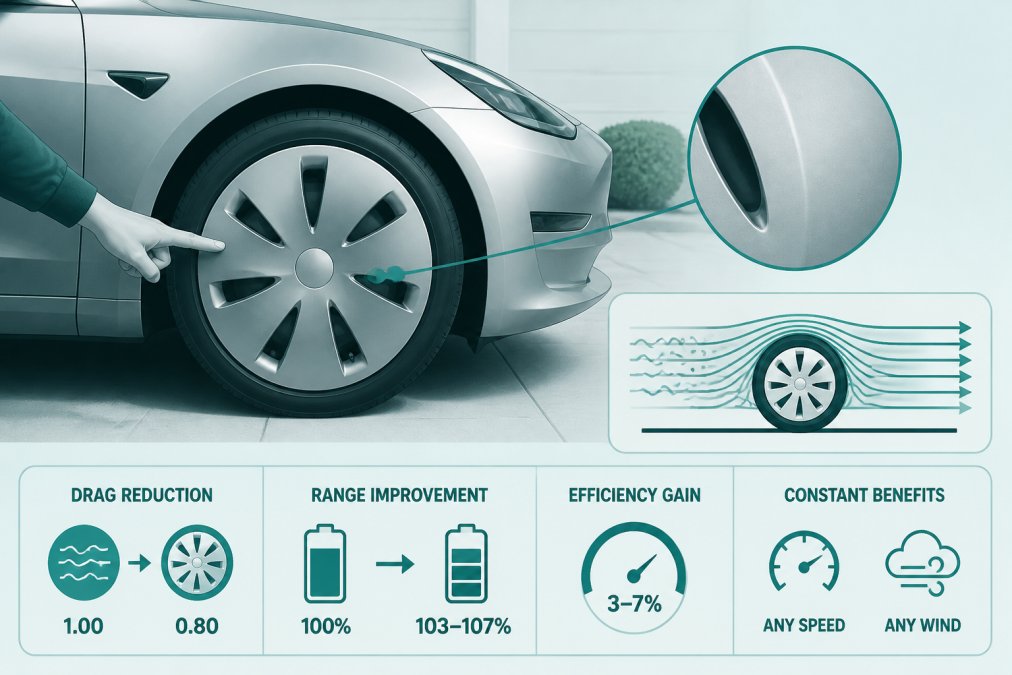
The effect is real but modest. Wheel covers influence a small slice of total vehicle drag, so treat any claim of double-digit range gains with suspicion.
Real-World Efficiency Gains and Range Improvement
Real-world testing puts the range benefit at roughly 2% to 4%, not the 10% some marketing copy implies. Teslaunch's analysis of wheel turbulence found that minimizing wheel turbulence reduces total aerodynamic drag by up to 5%, which translates to that 2% to 4% range increase.
Owner testing backs this up. A Tesla Model 3 owner ran 100-mile loop tests with and without Aero covers and logged up to 10 extra miles of range, documented in Tesla Motors Club forum testing. A Cybertruck owner reached the same conclusion across two roughly 800-mile interstate trips. The gains are consistent, but they are a bonus, not a transformation.
Speed-Dependent Efficiency
The efficiency bonus scales with speed. Forum data from Tesla Motors Club shows a 0.8% gain at 50 mph, rising to 1.5% at 60 mph. At 70 to 90 mph, Car and Driver measured the full 3.4% average. Below 40 mph, the benefit is close to negligible.
That matters for how you drive. If your commute is stop-and-go city traffic, covers do little for range. If you spend hours at highway speed, they earn their place.
Wheel Size Changes the Math
Wheel diameter and tire sidewall height change how much of the wheel face the air actually sees. A larger wheel with a shorter sidewall exposes more open spoke area, so the same cover removes more turbulence, and the gain grows. A smaller wheel with a tall sidewall already presents less open area, so the cover has less drag to erase. That is why a 20-inch performance wheel typically shows a bigger percentage gain than an 18-inch aero wheel on the same model. If you are shopping by trim, check the factory wheel size before you assume the cover will deliver the same result your neighbor got.
Temperature and Seasonal Effects
Cold weather shrinks the benefit in two ways. First, denser cold air increases overall aerodynamic drag, so every aero improvement, including covers, operates against a larger baseline. Second, cold temperatures cut usable battery capacity and raise rolling resistance through stiffer tire compounds, so the same 2% to 4% gain represents fewer real miles. A cover that adds 10 miles in mild weather may add only 5 to 7 in freezing conditions. The cover still helps; it just cannot outrun winter.
What the Numbers Mean for You
Use your trip meter, not the marketing sheet. Note miles per kilowatt-hour over a week with covers installed, then repeat the same commute without them. A consistent 0.1 to 0.2 mi/kWh difference is a real result. Anything smaller is inside normal day-to-day variation from wind, traffic, and temperature.
Do Hubcaps Affect Electric Car Range?
Hubcaps affect electric car range in the same way as any wheel cover: by changing airflow over the wheel. The term is interchangeable in practice. A hubcap that covers the wheel face smoothly reduces drag; a decorative one with an open, slotted design does not.
The key variable is surface coverage, not the label on the box. Full-cover designs and wheel skins that present a continuous flat surface deliver the aerodynamic profile that cuts wind resistance. Open designs, even attractive ones, leave the turbulence problem in place.
Best Aerodynamic Wheel Covers for Electric Vehicles
The best aerodynamic wheel covers for electric vehicles are full-coverage, direct-fit designs that seal the wheel face and match your factory wheel diameter. Fit matters more than brand. A cover that sits proud of the rim or leaves gaps creates its own turbulence and cancels the benefit.
When you shop, check three things:
- Coverage: Full-face designs beat partial covers for drag reduction.
- Fitment: Direct-fit covers matched to your model and wheel size seat flush.
- Material: ABS plastic holds its shape at highway speed; thin generic covers flex and rattle.
WheelCovers.Com stocks over 1 million hubcaps, wheel covers, wheel skins, and trim rings, including aerodynamic sets for EVs, with nationwide shipping and an easy online ordering process. You can find your exact fit without sifting through salvage yards.
| Priority | What to Check | Why It Matters |
|---|---|---|
| 1 | Full wheel-face coverage | Reduces turbulence and drag |
| 2 | Exact model and wheel-size fit | Prevents gaps and vibration |
| 3 | Rigid ABS construction | Holds shape at highway speed |
| 4 | Secure retention clips | Prevents loss at speed |
How to Improve Electric Vehicle Efficiency
Improving electric vehicle efficiency is mostly about reducing load and drag, and wheel covers are one lever among several. Pair them with these habits for the biggest combined gain:
- Keep tires at recommended pressure. Underinflation raises rolling resistance and eats range.
- Smooth your inputs. Hard acceleration and late braking waste energy that no accessory can recover.
- Precondition while plugged in. Cabin heating and cooling draw from the battery once you unplug.
- Cut highway speed slightly. Drag rises with the square of speed, so a few mph matters more than most drivers expect.
- Remove roof racks and cargo boxes when you're not using them.
Watch kilowatt-hour consumption on your trip meter. Miles per kilowatt-hour is the number that tells you whether a change actually helped.
Trade-Offs and Considerations
Every aerodynamic cover involves trade-offs, and honest ones are worth naming. The efficiency gain is variable, not fixed. As Basenor's range analysis notes, actual improvement depends on speed, wheel size, and driving conditions, so two drivers with identical covers can see different results. The four trade-offs below are the ones most buyers only discover after the fact.
Brake Cooling: The Safety Trade-Off
A closed cover traps heat that an open wheel would shed. Under normal commuting, brake temperatures stay low enough that the effect is minor. Under repeated hard stops, mountain descents, towing, or track sessions, a full-coverage disc can push brake temperatures higher than the factory design intended. If you drive aggressively or tow, consider a cover with vented slots, or remove the covers for track days. Never install a solid disc over brakes you already know run hot.
Cold Weather and Winter Tires
Range drops in low temperatures regardless of covers, and the aerodynamic benefit does not offset that loss. Winter tires add a second variable: their softer compounds and deeper tread raise rolling resistance, which can erase the small aero gain entirely. Many drivers run steel wheels with winter tires and skip covers altogether for the season. If you do keep covers on in winter, check retention clips monthly, road salt and freeze-thaw cycles loosen them faster than summer driving does.
Noise: The Quiet Upside
Noise is the benefit owners mention most often after range. Smooth covers cut wheel-well wind noise at highway speed compared with open-spoke wheels, because the turbulent air that generates drag also generates sound. The difference is most noticeable between 60 and 75 mph. It is not a substitute for sound deadening, but it is a free secondary gain that most marketing copy ignores.
Material Durability and Longevity
Material choice determines how long a cover survives real roads. ABS plastic is the common choice: rigid enough to hold shape at highway speed, inexpensive to replace, and resistant to road salt. Carbon fiber is lighter and stiffer but costs several times more and offers no measurable aero advantage over well-formed ABS. Alloy covers resist flex best but dent on pothole strikes and are the hardest to source for a specific wheel size. Flexible generic covers are the worst of both worlds, they flex at speed, rattle, and lose retention clips within a season. For most drivers, a rigid ABS direct-fit cover is the durability sweet spot.
Frequently Asked Questions
How much range do aero covers add?
Real-world tests show aero covers can add up to 10 miles of range. Car and Driver's 2019 testing of a Tesla Model 3 found a 3.4% average efficiency improvement across 50, 70, and 90 mph, translating to roughly 10 extra miles. Gains vary with speed, wheel size, and driving conditions, but the benefit is measurable and increases at highway speeds.
Do aerodynamic wheel covers work to reduce drag?
Yes. Aerodynamic wheel covers minimize turbulence around the wheel well, reducing total aerodynamic drag by up to 5% according to Teslaunch (2024). This drag reduction directly improves energy efficiency. The effect is more pronounced at higher speeds, where wind resistance becomes the dominant force. For daily driving, the gains are modest but real, especially on highways.
What are the disadvantages of using a wheel cover?
Wheel covers can trap heat, potentially affecting brake cooling during aggressive driving. They may also be less durable than bare wheels, and some owners dislike the aesthetic. Additionally, covers can become loose or lost. However, for most drivers, the efficiency benefits outweigh these trade-offs, especially with regular checks and proper installation.
Are aerodynamic wheel covers worth the investment for daily driving?
For daily commuters, the range gain is small but consistent, often 1-3% depending on speed. If you frequently drive at highway speeds, the efficiency bonus can be more noticeable. The cost is relatively low, and they also protect wheels from curb damage. For EV owners looking to maximize every mile, they are a sensible, low-effort upgrade.