

Oct 02, 2026
Custom Wheel Covers for 2026 Models: A Buyer's Guide
Table of Contents
- Why Custom Wheel Covers for 2026 Models Are Worth Considering
- Materials That Last: ABS Plastic vs. Polycarbonate
- The Benefits of Aero Wheel Covers for Range and Efficiency
- Matte Black vs. Glossy: Matching Your Vehicle Trim
- 16 in Wheel Covers and Other Size Options for 2026
- How to Install Aftermarket Wheel Covers Without Damaging Your Wheels
- Cleaning, Maintenance, and Long-Term Wear
- Warranty and Legal Considerations Before You Buy
- Conclusion: Choosing the Right Custom Wheel Covers
- Frequently Asked Questions
Last Updated: October 2, 2026
Why Custom Wheel Covers for 2026 Models Are Worth Considering
The car wheel cover market was valued at USD 2,226.6 million in 2025 and is projected to grow at a CAGR of 4.6% through 2035, according to WiseGuyReports market analysis. That growth reflects a simple reality: replacing a lost or damaged cover costs far less than replacing a wheel. Custom wheel covers for 2026 models give owners a direct-fit way to restore factory looks or upgrade them, without a salvage yard hunt.
At WheelCovers.Com, we've supplied hubcaps and wheel covers for nearly 50 years, and the questions we hear most are about fitment, durability, and whether aftermarket covers actually hold up. This buyer's guide answers those directly.
Custom wheel covers are aftermarket or direct-fit covers designed to match a specific wheel diameter, bolt pattern, and trim style. They snap onto stock wheels, protect the rim from curb rash, and can shift the whole look of a vehicle.
Here's what most guides get wrong: they treat wheel covers as pure cosmetics. In practice, the material, fitment, and finish determine whether a set lasts two years or ten.
Below, we'll break down materials, aero efficiency, sizing, and installation so you can buy once and buy right.
Materials That Last: ABS Plastic vs. Polycarbonate
ABS plastic is a common material for aftermarket wheel covers, while polycarbonate (PC) offers higher impact resistance. Both handle daily driving, but they age differently under UV exposure and road debris.
ABS holds its shape well and resists cracking from minor impacts. It's also lighter and less expensive to produce, which is why most entry-level sets use it. The trade-off is brittleness in extreme cold.
Polycarbonate flexes further before breaking, which matters if you regularly clip curbs. According to HaloBLK's material durability comparison, PC covers resist cracking better than standard plastic over repeated impact testing.
How Material Choice Affects Curb Rash and Scratch Resistance
Curb rash is the number one reason owners replace covers. A cover that flexes slightly on contact absorbs the hit; a rigid one chips or cracks.
- ABS: Good scratch resistance, moderate impact tolerance, lighter weight
- Polycarbonate: Superior impact resistance, better cold-weather flexibility, higher price
- Coating quality: Matte and textured finishes hide scuffs better than high-gloss
The Benefits of Aero Wheel Covers for Range and Efficiency
Aero wheel covers smooth airflow across the wheel face, reducing drag and improving range efficiency on electric vehicles. The flatter and more closed the design, the greater the effect. But the size of that effect depends on three variables most guides ignore: vehicle speed, wheel weight, and how well the cover seals against the rim.
This matters most for EVs, where every mile of range counts. Directional designs and closed-face covers cut the turbulence that open-spoke wheels create. On a gas vehicle, the benefit is smaller but still measurable at highway speeds.
Weight Comparison: Stock vs. Aftermarket Covers
One of the most common questions we hear is whether aftermarket covers are heavier than the stock pieces they replace, and whether that weight difference cancels out the aero gain. The honest answer is that it depends on the material and the design.
Here's how the categories typically compare on a per-cover basis:
- Stock plastic covers (ABS): Often a lighter option.
- Aftermarket ABS covers: Similar to stock.
- Polycarbonate covers: Can be heavier than ABS.
- Metal wheel skins and trim rings: These are cosmetic add-ons rather than aero pieces and are not the right comparison for efficiency purposes.
For a full set of four, the spread between plastic options can be a few pounds. Unsprung mass at the wheel does affect ride and handling in theory, but durability and fit are important considerations.
If you want to verify the weight of a specific set, ask the seller for the per-cover weight before ordering. A reputable supplier will have it on hand.
What 100-Mile Loop Tests Reveal About Efficiency
Real-world testing is the only way to know if a cover delivers. Range Maker's 100-mile loop testing measured efficiency changes by running identical routes with and without aero covers installed.
Gains can be modest and depend on speed and driving style. Covers may help most in steady highway driving, where aerodynamic drag dominates energy use. At low city speeds, the aero benefit may shrink.
A common pattern in owner-reported testing is that gains may show up on long highway runs at steady speeds, while mixed city driving may show little to no measurable difference. That's consistent with how drag scales: aerodynamic forces rise with the square of speed, so the faster you go, the more a smooth wheel face matters.
Matte Black vs. Glossy: Matching Your Vehicle Trim
Matte black is the safer choice for most modern vehicles because it matches the satin and textured trim found on many 2026 models. Glossy finishes suit chrome-accented or sport trims.
A Tesla Model Y owner in a Tesla Model Y owners group reported that matte black aftermarket covers brought the car's look closer to the Performance trim. That's the pattern: finish should follow trim, not personal taste alone.
| Finish | Best Matched To | Maintenance | Hides Scuffs |
|---|---|---|---|
| Matte black | Satin trim, sport packages | Easy | Yes |
| Gloss black | Chrome accents, luxury trims | Moderate | No |
| Silver | Factory OEM look | Easy | Somewhat |
| Textured gray | Work trucks, base trims | Easiest | Yes |
Gloss shows every swirl and rock chip. Matte forgives them.
16 in Wheel Covers and Other Size Options for 2026
16 in wheel covers remain the most common size for compact sedans and older trucks, but 2026 models increasingly ship with 18, 19, and 20-inch wheels. Always match the cover to the wheel diameter, not the tire.
Fitment depends on more than diameter. Bolt pattern, wheel profile, and clip geometry all affect whether a cover seats properly. Factory specifications vary by trim, so a cover that fits one version of a model may not fit another.
- 16-inch: Compact cars, older trucks, budget replacements
- 18-inch: Mid-size sedans, crossovers, entry Tesla trims
- 19-20-inch: Performance trims, larger SUVs, newer EVs
For 2026 Tesla Model Y builds, retailers now publish guides targeting factory 19-inch Crossflow and 20-inch Helix wheels, per Yeslak's 2026 Model Y wheel cover guide. Sizing errors are the leading cause of returns.
How to Install Aftermarket Wheel Covers Without Damaging Your Wheels
Installing aftermarket wheel covers takes about 10 minutes per wheel and requires no special tools beyond a clean cloth and a firm hand. The key is aligning clips before applying pressure.
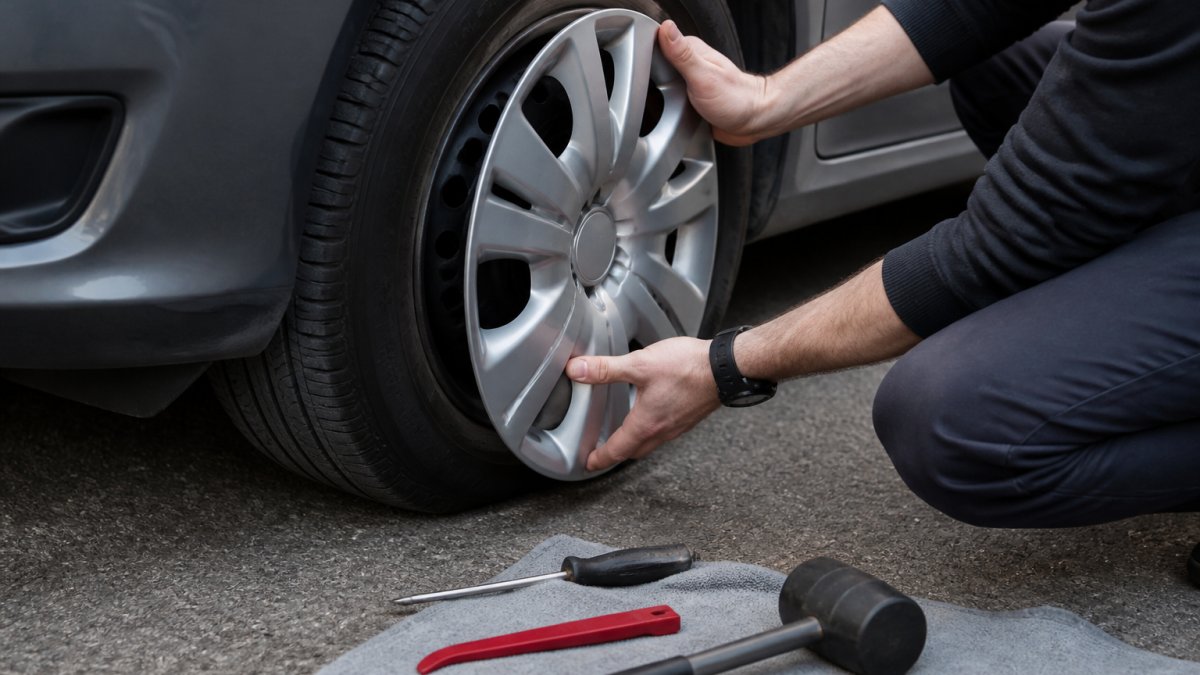
Total Time: 30-40 minutes for a full set Difficulty: Beginner
What You'll Need:
- Clean microfiber cloth
- Mild soap and water
- Soft rubber mallet (optional)
- Gloves
- Clean the wheel face. Remove brake dust and grime so clips seat fully.
- Check clip alignment. Match each tab to its slot before pressing.
- Start at the top. Seat the top clips first, then work downward.
- Press firmly around the rim. You should hear or feel each clip engage.
- Test the seal. Grip the cover edge and tug gently. It shouldn't shift.
Expected Result: A snug, rattle-free cover that sits flush against the wheel face.
Cleaning, Maintenance, and Long-Term Wear
Wheel covers last longest when washed every two to four weeks with mild soap and water. Skip abrasive brushes and harsh wheel cleaners, which strip coatings and dull finishes.
Long-term wear shows up in three places: faded finish from UV exposure, stress cracks near clips, and loosened retention tabs. Inspect clips each time you wash the car.
- Wash with mild soap, not acid-based cleaners
- Reapply a UV protectant spray every few months
- Check clip tension quarterly
- Rotate or replace covers showing hairline cracks
Weight is worth noting too. Lighter covers can reduce unsprung mass slightly. Durability and fit are important considerations.
Warranty and Legal Considerations Before You Buy
Aftermarket wheel covers generally do not void a vehicle's factory warranty, but they can affect coverage on related components if they cause damage. This is the question buyers ask us most often, and it deserves a direct answer rather than a one-line reassurance.
What Federal Law Actually Says
Federal law, under the Magnuson-Moss Warranty Act, prevents automakers from voiding a warranty simply because aftermarket parts are used. The FTC guidance on aftermarket parts and warranties explains that a manufacturer must show the part caused the failure to deny a claim. In plain terms: the burden is on the automaker, not on you.
That protection applies to aftermarket parts generally, and wheel covers are no exception. If a cover is properly installed and a wheel bearing fails, the automaker cannot deny the bearing claim just because a non-OEM cover was present, unless it can demonstrate the cover caused the failure.
Where Coverage Can Actually Be Affected
The realistic scenarios where a wheel cover could complicate a warranty claim are narrow but worth knowing:
- Wheel and tire coverage. Some tire-and-wheel protection plans (often sold separately from the factory warranty) exclude damage caused by aftermarket accessories. Read the plan terms, not just the factory warranty booklet.
- Suspension and steering components. If a cover is significantly heavier than stock and a related component fails, an automaker could argue the added unsprung mass contributed.
- Cosmetic and finish warranties. If a cover rubs against the wheel face and damages the factory finish, that damage is generally not covered, because the cover caused it.
- Lease returns. Lease agreements often require the vehicle to be returned in original condition. Aftermarket covers that alter the appearance may trigger a charge at turn-in, even if the factory warranty is unaffected.
How to Protect Yourself
A few practical steps reduce the risk of a warranty dispute:
- Keep your stock covers. If you ever need warranty work, you can reinstall the factory pieces before bringing the vehicle in.
- Document the install. A photo of the covers seated properly, plus the date, is useful if a question ever arises.
- Check the clip design. Covers that require no modification to the wheel are far less likely to trigger a coverage argument than anything that involves drilling, adhesive, or trimming.
- Read your specific warranty booklet. Coverage varies by automaker and by component. The Magnuson-Moss framework sets the floor, not the ceiling.
Track and Competition Rules
Legal questions also arise in competitive racing. A 2026 rule change now requires wheel covers secured with 3 bolts instead of Zeus buttons, as racing driver Tanner Holmes explained after transitioning his own setup. Street drivers face no such rules, but track users should verify local regulations and sanctioning-body requirements before running aftermarket covers at speed.
Conclusion: Choosing the Right Custom Wheel Covers
The right set of custom wheel covers for 2026 models comes down to three things: correct fitment, durable material, and a finish that matches your trim. Get those right and a cover set can outlast the wheel it protects.
WheelCovers.Com stocks over 1 million hubcaps, wheel covers, wheel skins, and trim rings, with nearly 50 years of experience matching parts to specific vehicles. Ordering online means no salvage yard trips and nationwide shipping to your door.
Get started with WheelCovers.Com and find a direct-fit set built for your exact model and wheel size.
Frequently Asked Questions
Do custom wheel covers affect vehicle range or efficiency?
Aerodynamic wheel covers can improve range by reducing drag, especially on electric vehicles. Range Maker's 100-mile loop tests show measurable efficiency gains with aero designs. However, heavy or poorly fitted covers may negate these benefits. For 2026 models, look for covers specifically designed for your wheel profile and made from lightweight ABS or polycarbonate to maximize range efficiency without adding unnecessary weight.
What is the best brand for wheel covers?
The best brand depends on your priorities: fitment accuracy, material durability, and style. For 2026 models, look for covers that use 3D scanning for a seamless fit and offer scratch-resistant finishes. WheelCovers.Com carries over 1 million hubcaps and wheel covers. Check customer reviews and warranty terms, and verify the cover matches your exact wheel diameter and factory specifications.
How do I know if a wheel cover will fit my 2026 model?
Fitment depends on wheel diameter (e.g., 16 in, 19 in) and the specific wheel design. Measure your wheel's diameter and note the trim level. Many aftermarket covers are designed for stock wheels like Tesla's 19-inch Crossflow or 20-inch Helix. Use the vehicle lookup tool on WheelCovers.com to confirm compatibility before ordering. If unsure, contact support with your VIN for a precise match.
What are the disadvantages of using a wheel cover?
Disadvantages include potential installation complexity and the risk of covers coming loose if not properly secured. Some users report that aftermarket covers may not match OEM finish exactly. Additionally, covers can crack or fade. Choosing durable materials like ABS or polycarbonate and following installation instructions carefully minimizes these issues.