

Posted by Editorial Team on Oct 12, 2026
BMW Centre Wheel Caps: Size, Fitment & Replacement Guide
Table of Contents
- BMW Wheel Center Caps: What Actually Fits Your Car
- BMW Wheel Center Cap Size: 56 mm vs 68 mm and What the Numbers Mean
- BMW Center Cap Fitment: Matching Caps to Factory and Aftermarket Wheels
- BMW Floating Center Caps vs Fixed Caps
- BMW Center Cap Replacement: Removal and Installation Step by Step
- Troubleshooting Loose, Stuck, or Missing Caps
- Genuine, Replica, and Pre-Owned Caps: How to Tell Them Apart
- Set Contents, Price Factors, and What to Check Before Ordering
- Caring for Your Caps and Knowing When to Replace Them
- Frequently Asked Questions
Last Updated: October 12, 2026
BMW Wheel Center Caps: What Actually Fits Your Car
BMW centre wheel caps are the small round covers that sit at the middle of an alloy wheel and carry the blue and white roundel, and choosing the right BMW centre wheel caps comes down to two numbers. Getting the right one comes down to two numbers, 56 mm or 68 mm, plus a check of your wheel's center bore. According to BimmerWorld's fitment notes on BMW wheel center caps, a cap with a 68 mm emblem fits most 1992-2016 BMW models and nearly all factory BMW wheels from that period.
That single spec explains why so many buyers order the wrong part. The car model tells you almost nothing on its own.
At WheelCovers.Com, we have spent nearly 50 years helping drivers source wheel accessories that actually fit. Below, we break down sizing, fitment, removal, and how to tell a genuine cap from a replica, so your first order is the right one.
BMW Wheel Center Cap Size: 56 mm vs 68 mm and What the Numbers Mean
The two dominant BMW wheel center cap sizes are 56 mm and 68 mm, and the number refers to the cap's outer diameter. A 56 mm cap suits smaller-bore wheels, while a 68 mm cap covers the wider factory alloys used across most of the 1992-2016 range.
The confusion starts because sellers describe caps in different ways. Some list the emblem diameter, others the full cap diameter. IND Distribution's guide to BMW floating center caps notes that its 56 mm caps pair with a 66.6 mm center bore, while its 68 mm caps carry an approximately 53.2 mm measurement. Those are two different dimensions of the same part.
How to Measure a Cap Before You Buy
Pull the old cap if you still have it, lay it face down on a flat surface, and measure straight across the widest point of the back edge with a ruler or calipers. That figure is your cap diameter.
If the cap is missing entirely, measure the wheel instead. Measure the center bore, which is the opening the cap seats into, and compare it against the spec sheet for your wheel design. A 5x112 bolt pattern tells you the wheel's lug spacing, not its cap size, so don't rely on it alone.
Write both numbers down before you shop:
- Cap diameter in millimeters
- Wheel center bore in millimeters
- Model year and wheel design name
BMW Center Cap Fitment: Matching Caps to Factory and Aftermarket Wheels
Fitment is where BMW center caps get genuinely tricky, because a cap that fits your car may not fit your wheels. Factory wheels follow predictable sizing, but aftermarket wheels often change the center bore, which changes which cap seats correctly.
For factory wheels, the 68 mm cap is the safe default across most 1992-2016 models, per BimmerWorld's fitment description. For aftermarket wheels, you need the wheel manufacturer's bore spec, not BMW's.
Center Bore, Bolt Pattern, and Model Year Checks
Run these three checks in order before ordering:
| Check | What to Confirm | Why It Matters |
|---|---|---|
| Center bore | Matches cap's seat diameter | Wrong bore means the cap won't seat or hold |
| Cap diameter | 56 mm or 68 mm | Determines which cap family you need |
| Model year | Within the wheel's production range | Confirms factory compatibility |
| Bolt pattern | 5x112 or your wheel's spec | Identifies the wheel, not the cap |
| Wheel type | Factory or aftermarket | Aftermarket needs its own bore figure |
A common mistake is trusting the model year alone. Two 2012 BMWs can leave the factory with different wheel designs and different cap requirements.
BMW Floating Center Caps vs Fixed Caps
BMW floating center caps are self-leveling caps that use a weighted, free-spinning inner assembly to keep the roundel upright while the wheel turns. Fixed caps are a single molded piece: the roundel is bonded to the cap body, so the logo rotates with the wheel and stops wherever the wheel stops.
That difference in construction drives everything else, price, fitment, installation, and how long the cap lasts.
How the Floating Mechanism Actually Works
Inside a floating cap there are two parts: an outer shell that snaps into the wheel's center bore and an inner disc that carries the roundel. The inner disc rides on a small bearing or bushing and is weighted at the bottom, so gravity keeps the logo level as the outer shell spins with the wheel. When the car stops, the roundel settles upright instead of landing at whatever angle the wheel happened to stop at.
A fixed cap has no inner disc, no bearing, and no weight. It is one piece of ABS plastic with a chrome ring and a printed or domed roundel.
Fitment: Floating Caps Are Not Universal
Floating caps are sold in the same two dominant sizes as fixed caps, 56 mm and 68 mm, but they are not a drop-in swap on every wheel. Two constraints matter:
- Bore depth. The floating assembly is thicker than a fixed cap because of the inner disc and bearing. A wheel with a shallow center bore may not have room for the mechanism to sit flush.
- Bore diameter. The outer shell still has to seat in the same center bore a fixed cap uses, so the 56 mm and 68 mm split applies the same way.
BMW USA's wheel accessories page lists floating caps in two sizes, which lines up with that 56 mm and 68 mm split. Before ordering, confirm your wheel's center bore and check whether the wheel manufacturer lists a minimum cap depth.
Installation Differences
Installation is the same five-step process as a fixed cap, clean the bore, pry the old cap free from the back edge, pull straight out, clean the bore again, press the new cap in until it seats. The difference is at the end: a floating cap needs to be pressed in evenly around the full rim so the inner disc is not pinched against the bore. If it goes in crooked, the roundel will stick instead of self-leveling.
Test it by spinning the wheel by hand after installation. The roundel should stay upright as the wheel turns. If it rotates with the wheel, the inner disc is bound up and the cap needs to be reseated.
The Honest Trade-Offs
| Factor | Fixed Cap | Floating Cap |
|---|---|---|
| Moving parts | None | Bearing or bushing plus weighted disc |
| Failure mode | Cracked tabs, faded roundel, peeling chrome | Sticking or seized inner disc |
| Cleaning | Wipe and wax like any plastic trim | Avoid high-pressure spray directly at the seam |
| Best use | Daily drivers, winter wheels, budget builds | Show cars, builds where the logo angle matters |
| Replacement | Simple one-piece swap | Same swap, but confirm bore depth first |
Floating caps cost more because of the extra assembly, and the mechanism is one more thing that can wear out. Road salt, grit, and repeated high-pressure washing are the usual culprits when a floating cap stops leveling. For a daily driver that sees winter road treatment, a fixed cap is the lower-maintenance choice. For a car that gets shown or photographed, the floating cap earns its keep every time the wheel stops.
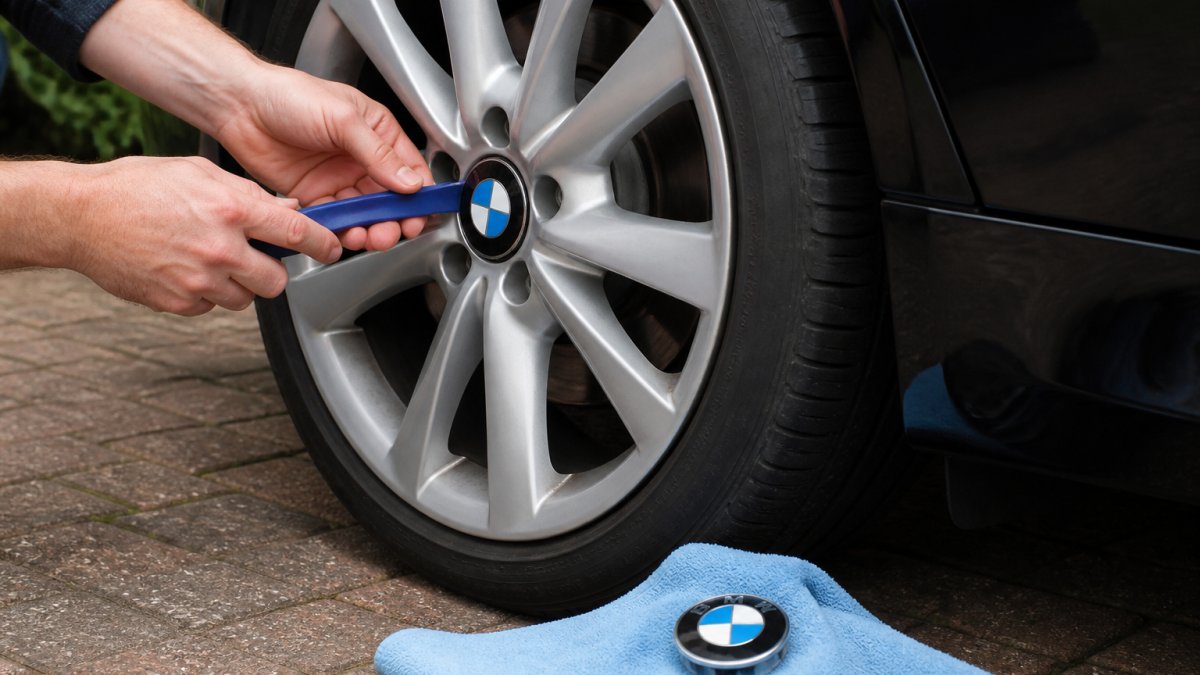
BMW Center Cap Replacement: Removal and Installation Step by Step
Replacing a BMW center cap takes about five minutes per wheel with basic tools. You do not need to remove the wheel.
Total time: 20-30 minutes for all four wheels Difficulty: Beginner
What you'll need:
- Plastic trim tool or a flathead screwdriver wrapped in tape
- Microfiber cloth
- Replacement cap
Step 1: Clean around the cap [Time: 2 minutes] Wipe the area around the cap so grit doesn't fall into the bore when you pry it loose.
Step 2: Pry from the back edge [Time: 2 minutes] Work the trim tool behind the cap's edge and apply steady pressure. Never lever against the wheel face, since that's how you chip a finish.
Step 3: Pull straight out [Time: 1 minute] Once the cap lifts, pull it straight toward you. Twisting can crack the plastic tabs that hold it in.
Step 4: Clean the bore [Time: 2 minutes] Wipe out the bore and check for debris or corrosion.
Step 5: Seat the new cap [Time: 2 minutes] Line up the cap and press it in with even pressure around the rim until it clicks or seats flush.
Expected result: A cap that sits flush, holds firm, and matches the other three.
Troubleshooting Loose, Stuck, or Missing Caps
A loose cap usually means a worn retaining tab or a bore that's slightly too large. Press it back in and check whether it holds. If it pops out again within a few days, the cap is the problem, not the installation.
A stuck cap is the opposite issue. Corrosion or road grime can fuse the cap to the bore, so apply a little penetrating oil around the seam and wait a few minutes before prying again.
Missing caps are the most common complaint, and they almost always trace back to a cap that was never fully seated. If you've lost more than one on the same wheel, check the bore for damage.
Genuine, Replica, and Pre-Owned Caps: How to Tell Them Apart
Most center cap listings use the same words, "OEM," "genuine," "factory style", and the photos rarely show the back of the cap, which is where the real differences live. Here is a practical checklist for telling the three categories apart before you buy.
Genuine Caps
A genuine BMW center cap has three things you can verify:
- A part number molded or printed on the back. BMW part numbers follow a standard format, typically an 11-digit number broken into groups (for example, 36 13 6 783 536). The number is on the back of the cap, not the front.
- Crisp roundel printing. The blue and white quadrants meet at clean, sharp edges. The chrome ring is even in width all the way around.
- Consistent color. The blue is a specific shade, not a generic royal blue. Faded or off-tone blue on a "new" cap is a red flag.
If the seller cannot show you a photo of the back of the cap with the part number visible, treat the listing as unverified.
Replica Caps
Replicas are aftermarket caps made to look like the factory part. They can fit and function fine, but the tells are usually visible up close:
- Soft or fuzzy logo edges. Replica roundels are often printed rather than molded, so the quadrant lines look slightly blurred.
- No part number, or a number that does not match BMW's format. Some replicas carry a generic number or none at all.
- Lighter weight. Replicas often use thinner plastic, which you can feel by comparing two caps in hand.
- Chrome ring that is painted rather than plated. Painted rings flake at the edges within a season or two.
None of that makes a replica a bad buy, it makes it a different product at a different price point. The problem is when a replica is sold as genuine.
Pre-Owned Caps
Pre-owned caps are real parts that have been on a car. They are the middle ground: genuine construction, but with wear. Check these before buying:
- Retaining tabs. Look for cracks or whitening at the base of each tab. A cracked tab is why the cap came off in the first place.
- Chrome ring condition. Peeling or dulling is common and hard to reverse.
- Roundel fade. Compare against a photo of a new cap; sun exposure fades the blue noticeably over years.
- Bore seating surface. Any deformation where the cap meets the bore means it may not hold.
For a driver, a clean pre-owned cap is a sensible buy. For a restoration, match the finish across all four, mixing a faded cap with three new ones is visible from ten feet away.
A Note on Hubcaps vs Center Caps
A center cap is not a hubcap. A hubcap covers an entire basic steel wheel, while a center cap covers only the middle of an alloy wheel. Buyers searching for one sometimes land on the other, and the two are not interchangeable.
Set Contents, Price Factors, and What to Check Before Ordering
Caps are sold individually and in sets, and the set is usually the better value if you're replacing more than one. A set of four keeps the finish, logo, and fit consistent across the car.
Pricing depends on whether you're buying genuine, replica, or pre-owned, and on whether you're buying one cap or a set. Marketplace listings for brand-new BMW center cap sets have appeared in a range from about $17.99 for a single listing up to $109.90 for a full set, according to eBay's BMW wheel center cap listings. That spread is wide because the listings differ in quantity, condition, and whether the caps are genuine.
Before you order, confirm:
- Exact cap diameter and center bore
- Quantity, single or set of four
- Condition, new or pre-owned
- Return policy if the fit isn't right
At WheelCovers.Com, we carry original and custom wheel accessories with nationwide shipping, so you can verify fitment and order without sifting through salvage yards. Our inventory covers more than 1 million hubcaps, wheel covers, and related parts.
Caring for Your Caps and Knowing When to Replace Them
Wash caps with the same soap you use on the rest of the wheel, and skip abrasive polishes on the chrome ring. A coat of wax a couple of times a year slows the dulling that comes from road salt and sun.
Replace a cap when the retaining tabs are cracked, the chrome ring has peeled, or the roundel color has faded enough to look mismatched against the other three. Catching a loose cap early saves you from buying a replacement later.
Frequently Asked Questions
Are all BMW center caps the same?
No. BMW wheel caps come in different diameters, most commonly 56 mm and 68 mm, and each size suits different wheel designs and model years. A 68 mm emblem cap is described as fitting most 1992-2016 BMW models and nearly all factory BMW wheels from that period, according to BimmerWorld. Because sizing varies, measure your existing cap or check the wheel's center bore before ordering rather than assuming every BMW takes the same cap.
How do I measure a BMW wheel center cap?
Pop the cap off and measure the diameter across the back face with a ruler or calipers, then compare it to the wheel's center bore. IND Distribution lists 56 mm caps with a 66.6 mm center bore and 68 mm caps with an approximately 53.2 mm measurement, which shows how the two sizes differ. Write down both numbers and match them to the listing before you buy.
Does BMW sell floating center caps, and how do they work?
Yes. BMW USA lists floating caps in two sizes, and IND Distribution describes a weighted mechanism that keeps the roundel upright while the wheel spins. They fit the same way as fixed caps but use a self-leveling design instead of a static emblem. If you like the always-upright look, floating center caps are the option to search for; otherwise, standard fixed caps are simpler and usually cheaper.
Are BMW center caps interchangeable between wheel models?
Only when the diameter and mounting style match. A cap that fits one factory wheel may not seat on another if the center bore or clip design differs, and aftermarket wheels often need a different size entirely. Check the cap diameter, center bore, and wheel design together. If you are unsure, measure your wheel and confirm the fitment notes on the product listing before ordering.
Losing a center cap mid-drive is a small problem that gets annoying fast, especially when you can't find a matching replacement locally. WheelCovers.Com stocks original and custom wheel accessories with nationwide shipping, backed by nearly 50 years in the business and an inventory of over 1 million parts. Check your cap diameter and center bore, then shop with us to get a cap that seats right the first time.