

Oct 04, 2026
Best Wheel Skins for Honda Civic: 2026 Buyer's Guide
Table of Contents
- Quick Comparison: Best Wheel Skins for Honda Civic by Model Year
- Wheel Size Compatibility: 16-Inch Steel Wheels vs 18-Inch Alloy Wheels
- Material Composition: ABS Plastic vs Polycarbonate in Wheel Skins
- How to Install Wheel Skins on Your Honda Civic
- 16 In Wheel Covers for Base Model Civics: What Actually Fits
- Aesthetic Upgrades: Chrome Delete, Gloss Black Finish, and OE Matching
- Durability and Long-Term Wear: What to Expect After a Year of Daily Driving
- Pricing Breakdown: What Wheel Skins and Wheel Covers Actually Cost
- Legal and Safety Considerations Before You Buy
- Conclusion: Choosing the Right Wheel Skins for Your Civic
- Frequently Asked Questions
Last Updated: October 4, 2026
Quick Comparison: Best Wheel Skins for Honda Civic by Model Year
The best wheel skins for Honda Civic owners depend on one thing above all: matching the cover to the wheel underneath it. Wheel skins are molded covers engineered to snap over an existing alloy wheel, while traditional hubcaps press onto bare steel wheels. Get that distinction wrong and nothing fits, no matter how good the price looks.
At WheelCovers.Com, we have supplied hubcaps, wheel covers, wheel skins, and trim rings for nearly 50 years, and fitment questions are still the number one reason customers call before ordering.
Here is how the current options break down by generation and wheel size:
| Civic Model Year | Wheel Type | Recommended Cover | Typical Style |
|---|---|---|---|
| 2023-2026 Sport / Sport Touring | 18-inch alloy | Gloss black snap-in wheel skin | Chrome delete, OE-look |
| 2022-2024 (multiple trims) | 18-inch alloy | Wheel overlay kit | Gloss black, reflective options |
| 2016-2026 sedan (base trims) | 16-inch steel | Snap-on wheel cover | Black with silver accents |
| 2016-2021 (10th gen) | 16-inch steel | Snap-on wheel cover | OE-matching silver or black |
The pattern is consistent: alloy wheels take wheel skins, steel wheels take wheel covers. Everything else in this guide builds on that single rule.
Wheel Size Compatibility: 16-Inch Steel Wheels vs 18-Inch Alloy Wheels
Wheel diameter is the specification that decides whether a cover snaps on cleanly or rattles loose within a week. Honda has shipped the Civic with both 16-inch steel wheels and 18-inch alloy wheels across recent generations, and the two require completely different products.
Matching Wheel Diameter to Your Civic's Trim Level
Check the sidewall of your tire first. A marking like 215/55R16 means a 16-inch wheel; 235/40R18 means an 18-inch wheel. Base and LX trims typically ride on 16-inch steel wheels, while Sport and Sport Touring models step up to 18-inch alloys.
That difference matters because a 16-inch cover physically cannot seat on an 18-inch rim. It will not stretch, and forcing it damages both the cover and the wheel finish.
- 16-inch steel wheels: snap-on hubcaps with retention clips
- 18-inch alloy wheels: snap-in wheel skins that hug the factory spoke pattern
- Never mix the two, even if the visual style looks identical online
Measure before you order. It takes 30 seconds and prevents the most common return in this category.
Material Composition: ABS Plastic vs Polycarbonate in Wheel Skins
Material choice decides how a wheel skin ages, not just how it looks on day one. ABS and polycarbonate behave differently under heat, impact, and UV exposure, and the right pick depends on whether the skin is snapping onto a 16-inch steel wheel or molding over an 18-inch alloy.
How ABS Actually Performs
ABS (acrylonitrile butadiene styrene) is the default for current 18-inch Civic wheel skins because it holds a molded shape and takes a high-gloss finish without hazing. Its weakness is UV: unpainted ABS chalks and yellows over years of sun exposure, which is why quality skins use a UV-stabilized clear coat or a painted top layer. Impact resistance is good at moderate temperatures but drops sharply in cold weather, which is why a clip that flexes fine in July can crack in January.
Where Polycarbonate Earns Its Place
Polycarbonate is tougher on impact and more dimensionally stable across temperature swings, but it is softer on the surface and scratches more readily than ABS. That trade-off is why it shows up most often in budget 16-inch covers, frequently blended with ABS. The blend keeps the retention clips flexible enough to grip a steel wheel without cracking, while the ABS portion holds the visible face shape.
Side-by-Side Comparison
| Property | ABS | Polycarbonate | ABS/Polycarbonate Blend |
|---|---|---|---|
| Impact resistance | Good (drops in cold) | Excellent | Good to excellent |
| Surface scratch resistance | Better | Softer | Moderate |
| UV stability | Needs clear coat | Better inherent | Depends on formulation |
| Gloss finish quality | Sharp, deep | Slightly softer | Good |
| Best use case | 18-inch alloy wheel skins | Heavy-impact covers | 16-inch snap-on covers |
What Actually Matters More Than Material
Fit tolerance and clip design outweigh material choice in real-world satisfaction. A well-molded ABS skin with tight tolerances will outlast a loose polycarbonate cover every time, because a cover that moves wears its clips and its finish. When you compare listings, look for stated fitment by wheel diameter and retention style before you compare plastic types.
How to Install Wheel Skins on Your Honda Civic
Learning how to install wheel skins takes about 30 minutes for a full set, and you can do it in a driveway with basic hand tools. No balancing, no tire removal, and no shop visit required.
Start with the wheel that has the most visible curb rash. If the skin covers it cleanly, the rest will be easy.
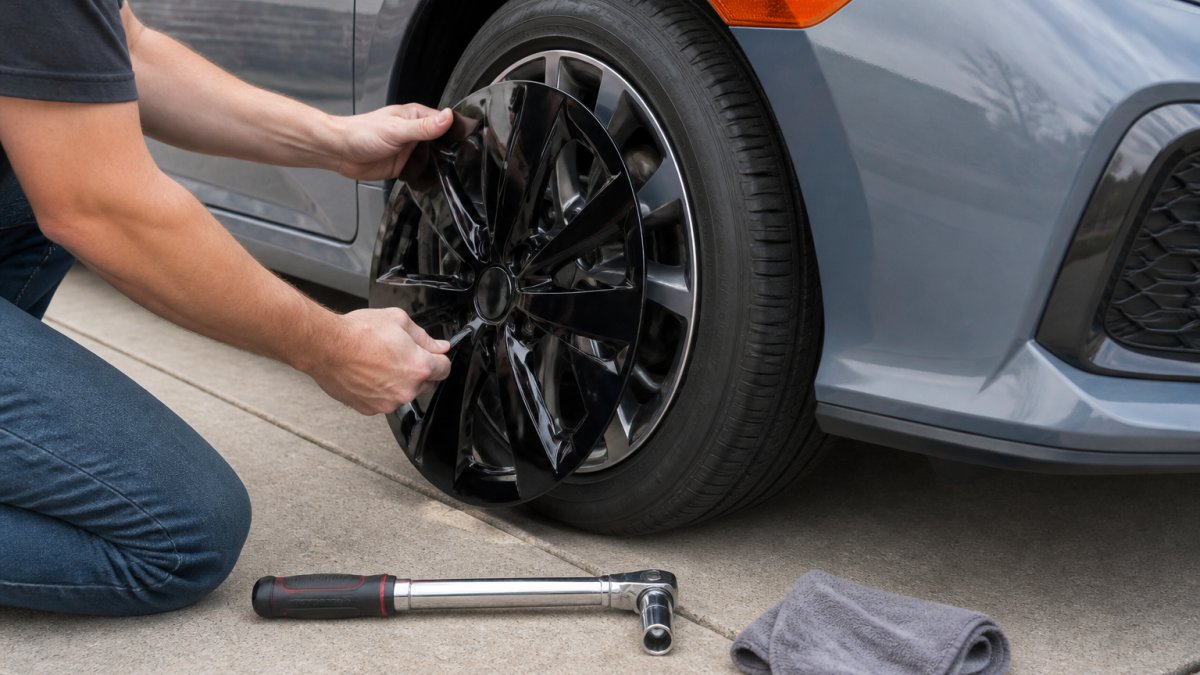
Tools and Prep You'll Need Before You Start
Gather everything before you touch the car:
- Microfiber cloths and a mild wheel cleaner
- Plastic trim tool or a flat plastic scraper
- Isopropyl alcohol for a final wipe-down
- Work gloves
- A soft mat to set covers on
Clean the wheel thoroughly and let it dry. Dust trapped under a skin shows through a gloss finish and can prevent the clips from seating fully.
Troubleshooting Snaps, Gaps, and Loose Fits
Most installation problems trace back to three causes: a bent clip, a dirty mounting surface, or the wrong product for the wheel type.
- Cover snaps but sits proud: one clip is not seated. Remove it and check for debris or a bent tab.
- Visible gap at the rim edge: the cover is the wrong diameter or the wrong style for an alloy wheel.
- Cover spins freely: retention clips are worn or the cover is a steel-wheel design on an alloy rim.
16 In Wheel Covers for Base Model Civics: What Actually Fits
16 in wheel covers for the Civic sedan are designed for steel wheels, and current inventory for 2016-2026 models includes full-rim designs in black with silver snap-on accents and white-rimmed styles. These covers use a combination of ABS and polycarbonate built for a secure fit on 16-inch rims.
Steel wheel customization has grown steadily in Civic communities. One owner on r/civic discussion of budget wheel upgrades replaced stock hubcaps with a $45 set of aftermarket 16-inch covers and reported the result looked better than the factory originals. That is the value case for steel wheels in a nutshell: a full set costs less than a single alloy wheel, and you can change the look every season.
What to check before ordering a 16-inch set:
- Confirm the tire sidewall reads R16
- Match the retention style to your wheel (snap-on clips vs. bolt-on)
- Verify the cover clears the valve stem
Aesthetic Upgrades: Chrome Delete, Gloss Black Finish, and OE Matching
Gloss black wheel skins have become the default aesthetic upgrade for 11th-generation Civics. The chrome delete look, where bright trim gives way to blacked-out accents, now extends to wheels, and gloss black skins deliver it without paint or powder coating.
Two paths exist, and they serve different buyers.
OE matching reproduces the factory finish. If you lost a cover or want the car to look untouched, this is the route. It keeps resale presentation clean and avoids any question about what was changed.
Aftermarket styling goes further. Wheel overlay and chrome delete kits for 2022-2024 models start around $50, and some designs integrate 3M reflective material for visibility at night. Oakman Designs applied reflective wheel skins and caliper skins to a 2022 Civic Touring, producing a look that reads factory at a glance but shifts under headlights.
Neither approach is better. Pick based on whether you want the car to look original or to look yours.
Durability and Long-Term Wear: What to Expect After a Year of Daily Driving
Most guides stop at "they hold up well." That is not useful when you are deciding whether to spend $150 on a set. Here is the wear sequence a Civic owner can actually expect across 12 months of daily driving, plus the conditions that accelerate it.
The Wear Sequence, Month by Month
- Months 1-3: Nothing visible. This is when a bad fit reveals itself, not wear. If a cover is going to rattle or sit proud, it does so in the first few weeks.
- Months 3-6: Retention clips begin to fatigue on steel-wheel snap-on covers. The cover still holds, but it takes less force to remove.
- Months 6-9: The outer edge finish shows the first scuffs from curb contact and car wash brushes. Gloss black hides this better than chrome or silver.
- Months 9-12: On reflective or clear-coated designs, the top layer can dull if acid-based wheel cleaners were used regularly. Clips on alloy-wheel skins, which rely on a molded fit rather than grip, typically outlast steel-wheel clips.
The Three Conditions That Shorten Lifespan
Road salt. Winter salt spray does not eat ABS or polycarbonate directly, but it attacks the metal retention hardware and any exposed fasteners on bolt-on designs. Rinsing the wheels after a salt event is the single highest-value maintenance step.
Extreme heat. Brake heat radiates into the wheel and the skin. Factory-fit skins clear standard calipers, but a skin that sits close to a hot rotor can soften its finish over repeated heat cycles. This is a clearance issue, not a material failure.
Automatic car wash brushes. Spinning brushes catch the lip of a cover and can pull it partially free. Touchless washes avoid this entirely. If you use a brush wash, check clip seating afterward.
What Wears Out First, In Order
- Retention clips (steel-wheel snap-on covers)
- Outer edge finish (curb and brush contact)
- Clear coat on reflective designs (harsh cleaners)
- The cover face itself (rarely, unless impact damage occurs)
The 12-Month Verdict
A quality ABS skin on an 18-inch alloy wheel, cleaned with mild soap and kept out of brush washes, commonly looks close to new at 12 months. A budget 16-inch cover on a steel wheel in a salt-belt state will show clip fatigue and edge scuffs by the same point, but usually still functions. The variable that matters most is not the material label on the listing. It is fit, clip design, and how you wash the car.
Budget for clip replacement, not cover replacement. Clips are the consumable part, and a set that fits correctly will outlast the hardware that holds it.
Pricing Breakdown: What Wheel Skins and Wheel Covers Actually Cost
Wheel skin pricing tracks closely to wheel size and material. Premium snap-in gloss black skins for 18-inch alloy wheels run about $149.95 per set of four, while aftermarket 16-inch covers for steel wheels start near $45. Documented DIY installs average around $120 in parts for a full set.
| Option | Wheel Type | Typical Set Price | Best For |
|---|---|---|---|
| Gloss black snap-in skins | 18-inch alloy | ~$149.95 | Sport and Sport Touring trims |
| Wheel overlay kits | 18-inch alloy | From $50.00 | 2022-2024 models, chrome delete look |
| Aftermarket 16-inch covers | 16-inch steel | From $45 | Base trims, budget refresh |
| OE-style replacement covers | 16-inch steel | Varies by model | Restoring factory appearance |
For current pricing on specific Civic fitments, check our product listings directly, since prices shift with inventory.
Legal and Safety Considerations Before You Buy
Wheel covers and skins are cosmetic parts, and no federal regulation requires approval for their use on passenger cars. That said, a few practical safety points deserve attention.
- Secure retention matters. A cover that separates at speed becomes a hazard to other drivers.
- Bolt-on designs need periodic checks. Fasteners loosen with vibration over time.
- Do not obstruct the valve stem. You need clear access to check and inflate tires.
- Avoid covers that contact brake components. Clearance issues can cause heat buildup.
If you drive a Civic with aftermarket brake calipers, verify clearance before ordering. Most factory-fit skins clear standard calipers, but larger aftermarket setups can interfere.
Conclusion: Choosing the Right Wheel Skins for Your Civic
The right choice comes down to two facts you can verify in a minute: your wheel diameter and whether it is steel or alloy. Everything else, style, finish, and price, follows from there.
At WheelCovers.Com, we stock over 1 million hubcaps, wheel covers, wheel skins, and trim rings, with fitment data built from nearly 50 years of supplying these parts. Our online ordering walks you through your exact model year and trim, and nationwide shipping means you skip the salvage yard entirely.
Shop now and get the right fit the first time.
Frequently Asked Questions
Are wheel skins the same as hubcaps?
No. Wheel skins are designed to fit over existing alloy wheels, acting as simulators that change the look without replacing the rim. Hubcaps, or wheel covers, are made for steel wheels and snap onto the bare rim. Confusing the two leads to fitment errors, since an 18-inch alloy wheel skin will not snap onto a 16-inch steel wheel. If you drive a Civic with factory alloy wheels, you want wheel skins. If you have base-model steel wheels, look for 16 in wheel covers instead.
Do wheel skins damage the original rims?
Snap-in wheel skins are designed to grip the wheel's outer lip without scratching the finish when installed correctly. Damage usually comes from prying them off with metal tools or forcing a skin that does not match your wheel diameter. Use a plastic trim tool for removal, clean the rim before installing, and confirm the skin matches your exact wheel style. If you follow those steps, the factory finish underneath stays intact and you can return to the stock look at any time.
How do I know what size wheel skin fits my Honda Civic?
Check the tire sidewall first. A 235/40R18 tire means an 18-inch wheel, and a 215/55R16 means 16 inches. Then confirm the wheel style, since 2023-2026 Civic Sport models use 18-inch alloy wheels that take snap-in gloss black skins, while older sedans with steel wheels take 16-inch covers. Wheel diameter alone is not enough; the cover style must match the underlying wheel. Measure twice, then order the set of four that lists your exact model year and trim.
Can I install wheel skins myself without professional tools?
Yes. Installation is a DIY-friendly process that most owners finish in under an hour using no specialty equipment. You need a clean cloth, a plastic trim tool for any adjustments, and a flat surface. Line up the valve stem cutout, press the skin onto the wheel lip working around the circumference, and confirm each clip seats fully.