

Posted by Editorial Team on Oct 17, 2026
Best Aerodynamic Wheel Covers 2026: EV Range Guide
Table of Contents
- Why Aerodynamic Wheel Covers Matter in 2026
- Aerodynamic Wheel Covers Range Improvement: What the Numbers Show
- Wheel Cover Efficiency Testing: How Gains Are Measured
- Wheel Cover Size Guide: Matching Covers to Your Wheels
- Tesla Model Y Aero Wheel Covers and Other EV Fitments
- Aero-Cover Styles, Materials, and Durability
- Pricing, Set Contents, and What You Get
- Road-Going Aero Covers vs. Racing Wheel Covers
- How to Choose the Best Aerodynamic Wheel Covers for Your Car
- Frequently Asked Questions
Last Updated: October 17, 2026
Why Aerodynamic Wheel Covers Matter in 2026
Aerodynamic wheel covers are smooth-faced wheel accessories that manage airflow around the tire and rim to reduce drag. In 2026 they matter more than ever because the electric vehicle market keeps expanding, and every mile of range counts. This guide from WheelCovers.Com breaks down the best aerodynamic wheel covers in 2026 by fitment, materials, and real-world efficiency evidence.
Market forecasters are paying attention. Dataintelo's aero wheel cover market report estimates the category at $3.07 billion in 2025, growing to $5.11 billion by 2034 at a 5.8% CAGR. That growth tracks the rise of EVs, where aero covers often ship from the factory.
But here's what most guides get wrong: they promise a fixed range boost. The truth is messier. Gains depend on speed, wheel size, and driving style, as Basenor's analysis of aero wheel cover range claims points out. Below, we'll show you exactly how to evaluate covers so you buy the right set the first time.
Aerodynamic Wheel Covers Range Improvement: What the Numbers Show
The most-cited real test comes from Car and Driver. Its Tesla Model 3 aero wheel cover efficiency test found the covers were 3.4% more efficient across three test speeds. That's a measured result, not a manufacturer estimate.
What does 3.4% mean in practice? On a 300-mile range estimate, that's roughly 10 miles, and only under the test conditions. The gain shrinks in stop-and-go traffic where aerodynamic drag matters less.
So who benefits most? Highway commuters and long-distance EV drivers. If your daily drive is 20 minutes of city streets, the efficiency payoff is modest. If you're logging interstate miles, aero covers earn their keep. The catch is that efficiency and appearance often pull in opposite directions, and you'll want to weigh both before ordering.
Wheel Cover Efficiency Testing: How Gains Are Measured
Wheel cover efficiency testing measures how much drag a cover removes compared with a bare alloy wheel. Engineers run controlled speed sweeps, often in a wind tunnel or on a closed track, and compare energy consumption at each speed.
Three variables drive the result:
- Speed: drag rises with the square of velocity, so highway gains outpace city gains
- Wheel size: larger wheels present more frontal area and change the airflow pattern
- Cover design: a full smooth cover beats a spoked or vented design for pure aero
This is why Car and Driver's three-speed test protocol matters. Testing at multiple speeds shows the gain isn't a single fixed number. When you read a review, check whether it names the speeds, the wheel size, and the vehicle. A test without those details tells you almost nothing.
Wheel Cover Size Guide: Matching Covers to Your Wheels
Wheel cover size is the single most common reason a set gets returned. Before you shop, find the wheel diameter stamped on your tire sidewall, such as 18, 19, or 20 inches. That number, not the tire width, determines which cover fits. But diameter alone is not enough, the matrix below adds the four variables that actually decide fitment: model year, wheel design, brake clearance, and retention method.
| Vehicle / Trim | Model Year | Wheel Diameter | Wheel Design | Brake Clearance Note | Retention Method |
|---|---|---|---|---|---|
| Model 3 (Highland) | 2024-2026 | 18 in | Aero-style alloy | Standard caliper, no spacer needed | Rim-edge clips |
| Model 3 Long Range | 2017-2023 | 18-19 in | Aero or sport alloy | Performance brakes may require open-face cover | Rim-edge clips or center cap |
| Model Y Long Range | 2020-2026 | 19-20 in | Aero or induction alloy | Verify caliper clearance on 20 in | Rim-edge clips |
| Model Y Performance | 2020-2026 | 21 in | Uberturbine-style alloy | Larger caliper; open aero recommended | Lug-mounted or center cap |
| Cybertruck | 2024-2026 | 20 in | Utility alloy | High ground clearance; check shield depth | Lug-mounted |
| Universal aftermarket | Varies | 15-20 in | Steel or alloy | Measure caliper-to-rim gap | Clip-on or strap |
Two fitment details trip people up. First, covers attach differently: some clip to the rim edge, others use the lug nuts or a center cap. Second, aftermarket alloys and standard steel wheels take different covers entirely. Measure twice, order once.
A standardized fitment check beats a generic "fits most EVs" claim every time. Work through the matrix in this order:
- Model year, mid-cycle wheel changes are common, so a cover for a 2022 model may not clip to a 2024.
- Wheel diameter, read the sidewall, not the tire width.
- Wheel design, spoke pattern and face profile determine whether a full cover sits flush.
- Brake clearance, performance trims often need open-face designs.
- Retention method, clip-on, lug-mounted, or center-cap covers are not interchangeable.
A cover listed as fitting "18-inch wheels" may still fail on a specific trim because of brake caliper shape or spoke offset. Always confirm the retention method and brake clearance note before checkout.
Tesla Model Y Aero Wheel Covers and Other EV Fitments
Tesla owners drive much of the demand here. Model Y aero wheel covers come in several styles, from Uberturbine-inspired designs to full smooth covers. Listings like Yeslak's Model 3 Highland wheel cover lineup show vehicle-specific products priced around $209.99 for a set, which gives you a sense of the upper end for premium aftermarket sets.
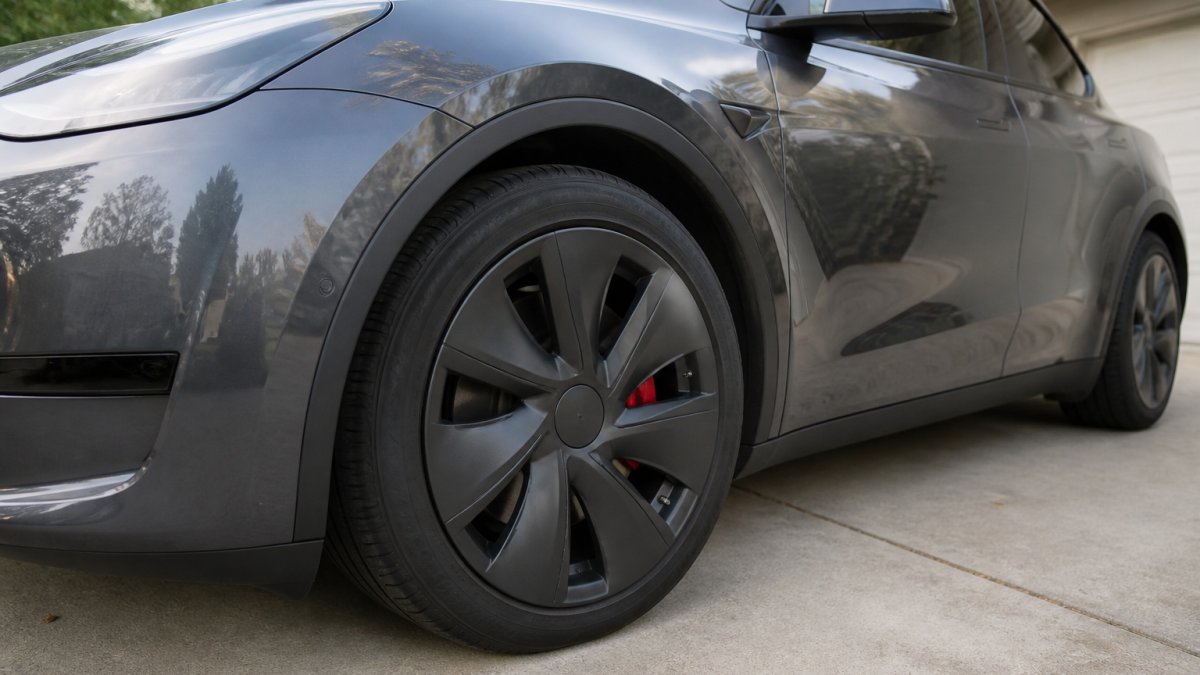
Beyond Tesla, the fitment landscape is fragmented. Model 3, Model Y, and Cybertruck each use different wheel geometry, so a cover built for one won't fit another. Other EV brands vary just as widely. That's why a standardized fitment check beats a generic "fits most EVs" claim every time.
At WheelCovers.Com, we stock covers by vehicle and wheel size rather than by vague category, so you can match your exact model before checkout.
Aero-Cover Styles, Materials, and Durability
Style choices come down to three families: full smooth covers, hybrid covers with partial openings, and open aero designs that show more of the wheel. Full covers deliver the strongest aero benefit. Open designs look sportier but give back some of the drag savings.
Materials matter for durability. Most covers use ABS plastic, sometimes with a painted or textured finish. Cheaper sets crack at the clip points after a season of potholes and curb scrapes. Better sets use thicker plastic and reinforced mounting tabs.
What most reviews miss is the clip system. A cover that snaps on securely and removes without tools is worth more than a prettier one that rattles loose at highway speed. Check the warranty too: a set backed for a year or more signals the maker trusts its plastic.
Pricing, Set Contents, and What You Get
Pricing for aerodynamic wheel covers varies widely by vehicle, material, and whether you're buying original-style or custom covers. Rather than publish a single number that goes stale, the table below shows the materials, included parts, and warranty terms that actually affect value.
| Category | Typical Price (Set of 4) | Material | Included Parts | Warranty |
|---|---|---|---|---|
| Factory-style replacement | $120-$180 | ABS plastic, textured finish | 4 covers, clips, center caps | 90 days-1 year |
| Premium aftermarket aero | $180-$260 | Thicker ABS, painted finish | 4 covers, reinforced clips, removal tool | 1 year |
| Custom or vehicle-specific | $200-$300 | ABS or composite | 4 covers, logo inserts, mounting hardware | 1-2 years |
| Universal fitment | $60-$120 | Basic ABS | 4 covers, strap or clip kit | 30-90 days |
What should a complete set include? Look for:
- Four covers, one per wheel
- A center cap or logo insert where the design calls for it
- Mounting clips or retention rings
- A removal tool, on better sets
- Fitment instructions specific to your wheel
A set of four is standard, but some listings sell pairs. Read the quantity before you buy. And confirm the return policy covers fitment issues, because a cover that doesn't clip on is useless no matter how good it looks.
Three value traps to watch for:
- Cheap clips, the clip system, not the plastic face, is what fails first. A set with reinforced tabs and a spare clip kit is worth the premium.
- Missing hardware, a listing that shows four covers but no clips or center caps will cost you a second order.
- Short warranty, a 30-day warranty on a part that sees curb scrapes and car washes is a signal the maker expects failures.
We don't publish fixed prices because fitment and finish change the number, so check current pricing on our site for your specific model.
Budget for the clip system and warranty, not just the cover face. A set with a one-year warranty and spare clips usually outlasts a set that needs replacing after one winter.
Road-Going Aero Covers vs. Racing Wheel Covers
Road-going aero covers and racing wheel covers serve different jobs. Racing covers, sometimes called Dirt Defender-style shields, protect wheels from mud and debris in off-road or dirt-track use. They're built for abuse, not efficiency.
Road-going covers prioritize smooth airflow and clean styling for daily driving. They're lighter, quieter, and designed to survive curb scrapes and car washes. Mixing the two up leads to disappointment: a racing shield on a commuter car looks out of place and adds weight, while a street cover won't survive a dirt track.
If you drive an EV on paved roads, you want the road-going category. If you're prepping a truck for off-road weekends, the shield style makes sense. Know which job you're buying for.
How to Choose the Best Aerodynamic Wheel Covers for Your Car
Choosing the best aerodynamic wheel covers comes down to a short checklist. Work through it before you order, and you'll skip the returns cycle.
- Confirm your wheel diameter from the tire sidewall
- Identify your attachment type: clip-on, lug-mounted, or center-cap
- Decide your priority: maximum aero, factory look, or sporty styling
- Check material and warranty for durability
- Verify the set includes four covers and hardware
- Confirm the return policy before checkout
A common mistake is buying on looks alone and discovering the clips don't match. Another is assuming a cover for one trim fits another. Our fitment-first approach at WheelCovers.Com exists precisely because these mismatches are so frequent.
The best aerodynamic wheel covers for your car are the ones that fit your exact wheel size and attachment style, backed by a real warranty. Aero gains are a bonus, not a guarantee.
Frequently Asked Questions
Do aerodynamic wheel covers improve electric vehicle range?
They can, but the gain is smaller than marketing often suggests. Car and Driver tested a Tesla Model 3 with aero wheel covers across three speeds and measured a 3.4% efficiency improvement. That is a real but modest change, and it varies with speed, wheel size, and driving conditions. Basenor notes the effect depends on factors like speed and wheel size, so you should not assume a fixed mileage increase. Treat aero covers as one small efficiency lever, not a guaranteed range boost.
How do I choose the right wheel cover size for my vehicle?
Start with the wheel diameter stamped on your tire sidewall, such as 18-inch or 19-inch, then confirm the cover is listed for your exact model and trim. Wheel design matters too: a cover built for one factory wheel style may not seat correctly on another. Measure the wheel's outer diameter and check the product listing for vehicle compatibility before ordering. If you are unsure, give the seller your year, make, model, and wheel size so they can confirm fitment.
Are aftermarket aerodynamic wheel covers worth it for an EV?
It depends on what you want from them. If you are chasing a measurable efficiency gain, the evidence points to small improvements, such as the 3.4% figure Car and Driver recorded on a Model 3. If you want to replace a lost or damaged cover, protect the wheel from road debris, or change the look of the car, aftermarket covers can make sense at a lower cost than factory parts. Check fitment and material quality first, since a loose cover is a safety concern.
Do aerodynamic wheel covers work at highway speeds?
Aerodynamic effects grow with speed, so covers have more opportunity to reduce drag at highway speeds than in stop-and-go traffic. Car and Driver's Model 3 test measured efficiency across three test speeds and found a 3.4% improvement overall. That does not mean the gain is identical at every speed. Basenor cautions that results depend on speed and wheel size, so expect the benefit to vary with how and where you drive rather than staying constant.
Aero covers reward buyers who do the fitment homework first. The efficiency evidence is real but conditional, and the wrong size wastes both money and time. WheelCovers.Com has spent over 47 years matching drivers with the right covers, with a nationwide inventory of more than 1 million hubcaps, wheel covers, wheel skins, and trim rings, easy online ordering, and shipping direct to your door. Get started with WheelCovers.Com and find the set that fits your vehicle the first time.