

Posted by Editorial Team on Nov 01, 2026
Are Locking Hubcap Clips Worth It? A Straight Answer
Last Updated: November 2, 2026
Quick Summary
Locking hubcap clips hold a wheel cover on with a keyed fastener that requires a matching tool to release, so covers resist the vibration and flex that shake plain clips loose. They also deter casual theft and reduce how often covers need replacing. They work best on steel wheels with full covers.
- A standard clip holds by spring tension alone, while a locking clip adds a mechanical lock on top.
- Inspect the retention ring first: if it is bent, rusted, or cracked, no clip will hold.
- Match the cover to the wheel's rim diameter, the last figure in a tire size like 225/60R16.
- Install clips around the circumference rather than tightening one side first, and stop at firm resistance.
- Locking clips deter quick grabs but cannot stop a prepared thief with the right tool and time.
Table of Contents
- What Locking Hubcap Clips Actually Do
- The Real Benefits of Installing Locking Hubcap Clips
- How to Keep Hubcaps from Falling Off on Rough Roads
- Wheel Cover Compatibility: Which Covers Accept Locking Clips
- How to Install Hubcap Clips Step by Step
- Steel Wheels vs. Alloy Wheels: Where Clips Make Sense
- Common Mistakes That Weaken Clip Retention
- Do Locking Clips Stop Theft? What They Can and Cannot Do
- Ordering the Right Clips and Covers for Your Vehicle
- Frequently Asked Questions
What Locking Hubcap Clips Actually Do
Locking hubcap clips are small metal or plastic fasteners that grip the wheel's retention ring and hold a wheel cover in place, with a keyed version that requires a matching tool to release. They solve one problem: covers that loosen, rattle, or disappear. Drivers often lose covers on rough stretches of road, and the clip is frequently where the problem starts.
A standard clip generally holds by spring tension alone, while a locking clip adds a mechanical lock on top of that tension. That difference matters on rough pavement, on highway expansion joints, and in parking lots where a loose cover is easy to grab.
So what do the benefits of installing locking hubcap clips actually come down to? For a broader look at the benefits of investing in quality hubcaps, see our full article. Retention, security, and fewer replacements. Below, we'll show you exactly how each one works and where the limits are.
The Real Benefits of Installing Locking Hubcap Clips
A locked clip can resist the vibration and flex that shake a plain clip loose over time.
The second benefit is deterrence. A cover held by a keyed clip takes time and the right tool to remove. Most casual theft is opportunistic, and friction is often enough to send someone to an easier wheel.
Every cover that stays on is one that does not need replacing, which can add up for body shops and tire stores managing fleet vehicles.
- Fewer covers lost to vibration and potholes
- Harder for a passerby to pop off
- Less downtime for shops and fleets
- Longer service life from each cover
A loose cover can rub the rim and scuff the finish, so keeping the cover seated also helps protect the wheel.
How to Keep Hubcaps from Falling Off on Rough Roads
Rough roads punish covers in three ways: impact, vibration, and flex. Locking clips address all three, but only if the rest of the setup is sound.
Start with the retention ring. If it's bent, rusted, or cracked, no clip will hold. Inspect it before you install anything.
Then check the cover's own condition. A cracked cover flexes more, and flex is what pops clips free. Replace damaged covers rather than trying to save them.
Next, seat the cover fully before locking anything. A cover that isn't flush will work its way loose no matter how tight the clip feels.
Watch out: over-tightening a clip to stop a rattle often bends the retention ring, which makes the next cover fit worse. Fix the rattle at the source, usually a worn ring or a warped cover, instead of cranking down the hardware.
Wheel Cover Compatibility: Which Covers Accept Locking Clips
Not every wheel cover accepts a locking clip, and this is where buyers get burned. Learn how to avoid common mistakes when buying wheel covers so you pick covers that actually accept locking clips. Compatibility comes down to the attachment style molded into the back of the cover, the wheel diameter it was built for, and whether the locking hardware clears the center design. Most guides stop at "check the attachment style." The workflow below is the part they skip.
Step 1: Read the tire sidewall correctly
The number you want is the rim diameter, the last figure in a size like 225/60R16, that 16 is the wheel diameter in inches, and it is what a wheel cover must match. The 225 is section width in millimeters and the 60 is aspect ratio; neither tells you cover size. A common pattern is a buyer ordering a 17-inch cover because the tire "looks big," when the sidewall actually reads R16. Confirm the rim diameter on the sidewall before anything else.
Step 2: Measure the wheel, not the tire
With the cover off, measure across the flat mounting face of the steel wheel, the surface the cover's retention ring seats against, not across the outer tire bulge. A tape measure laid across the wheel's outer lip gives a workable diameter; most passenger-car steel wheels fall in the 14- to 17-inch range, and light-truck wheels run larger. If your measurement lands between two sizes, the cover is almost certainly the smaller nominal size, because covers are sized to the wheel's bead seat, not its outer flange.
Step 3: Photograph the back of the cover
Four views settle most identification questions:
- Front face: full cover, straight on, with a ruler or coin for scale.
- Back face: the retention ring, clip tabs, and any molded ribs.
- Center detail: the logo, emblem, or center-cap opening.
- Markings: any molded or stamped code, close enough to read.
Compare those four images against reference photos of the same vehicle year, make, model, and trim. Trim matters: the same nameplate can ship with different wheel sizes and cover designs by trim and production year, so a cover that fits a base model may not fit the sport trim.
Step 4: Find and interpret the part number
Molded or stamped codes usually sit on the back of the cover near the retention ring, on the inside of a spoke, or around the center hub. Original equipment codes often begin with a manufacturer prefix followed by a numeric sequence; aftermarket covers may carry a simpler catalog number. Write the full string down exactly, including any letters, and use it alongside the vehicle year, make, and model, the code alone can identify a cover family, but the vehicle details confirm the trim and wheel option.
Step 5: Confirm the attachment style
Look for a retention ring designed for clip hardware. Many original equipment covers and most quality aftermarket covers have one. Cheap universal covers often rely on friction alone and have nothing to lock onto. Check three things before you buy:
- Attachment style: does the cover use clips, or a snap-in ring?
- Wheel diameter: does the cover match the wheel, not the tire?
- Center design: does the locking hardware clear the center cap?
Also confirm the cover is meant for your wheel type. A cover built for a steel wheel won't seat correctly on an alloy wheel, and vice versa. That mismatch alone causes more lost covers than bad clips do.
If you're unsure which covers accept locking hardware, check the cover's attachment style and wheel diameter before ordering.
How to Install Hubcap Clips Step by Step
Installation time varies, and the steps below outline the process with basic hand tools. For a full walkthrough of securing clips and preventing loose covers, see how to install snap-on hubcaps step by step. Work on a flat surface with the wheel cool and clean. The steps below add the measurement and retention checks most walkthroughs leave out.
- Clean the retention ring. Wipe off dirt and rust so the clip seats flat. A clip sitting on grit cannot lock evenly.
- Inspect the cover. Check for cracks or bent tabs before you start. A cracked cover flexes and will pop clips free.
- Measure the ring profile. Run a tape or caliper across the retention ring's seating groove and compare it to the clip's specified profile. Clips are sized for specific ring profiles, so confirm the clip matches the ring before installing.
- Align the valve stem. Line up the cover's valve cutout with the stem.
- Seat the cover. Press evenly around the edge until it sits flush. A cover that isn't flush will work its way loose no matter how tight the clip feels.
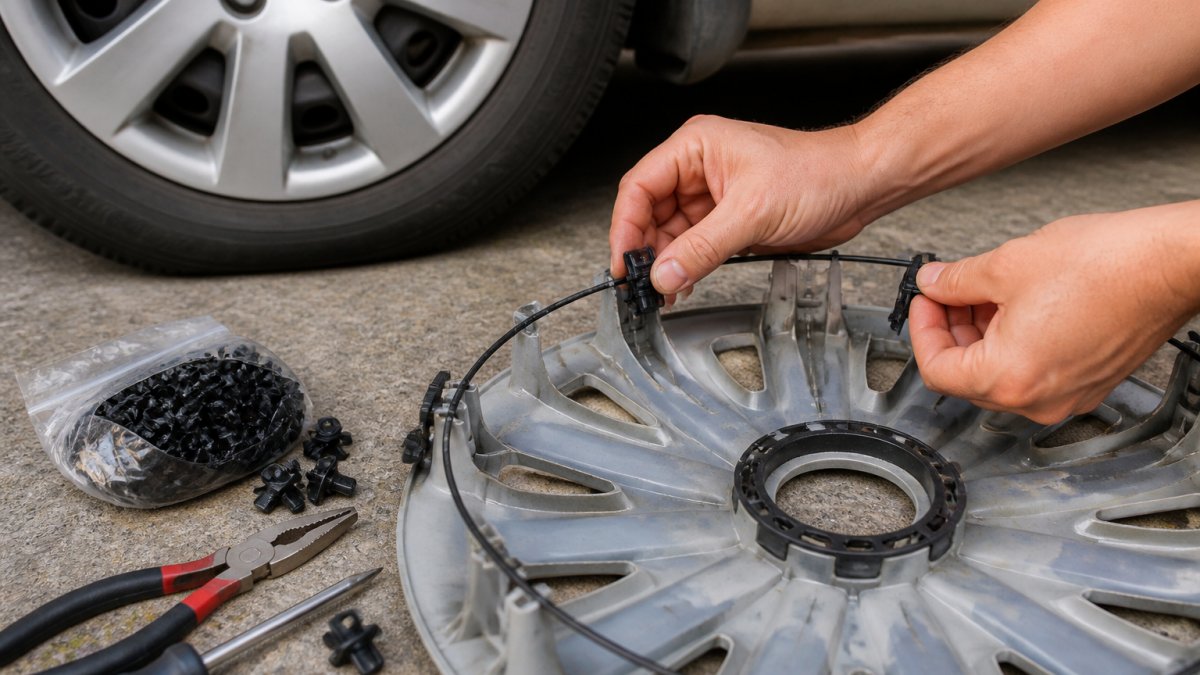
- Install the clips. Fit each locking clip onto the retention ring at the marked points, working around the circumference rather than tightening one side first.
- Lock each clip. Turn the key or fastener until it seats. Stop at the point of firm resistance, forcing it bends the retention ring, and a bent ring makes the next cover fit worse.
- Test the fit. Grip the cover at two opposite points and rock it gently. It should not move. Then press inward at each clip location to confirm none clicks or shifts.
- Check air pressure access. Confirm the valve stem is still reachable and the cap threads on cleanly.
Steel Wheels vs. Alloy Wheels: Where Clips Make Sense
Locking clips earn their keep on steel wheels. Steel rims flex slightly under load, and that flex is exactly what shakes a plain clip loose. A locked clip holds through it.
Alloy wheels are a different story. Many alloy wheels use center caps rather than full covers, and those caps often have their own bolt-on or snap-in mounting. Locking clips still work, but the fitment is fussier and depends on the specific cap design.
So which setup benefits most? For a deeper comparison of steel versus alloy hubcaps, see our full breakdown.
- Steel wheels with full covers: the strongest case for locking clips
- Alloy wheels with center caps: clips work if the cap accepts them
- Wheel simulators on trucks: clips help, but check the simulator's mounting style
Here is where locking clips make the most sense by wheel type.
| Wheel setup | Do clips make sense? | Note |
|---|---|---|
| Steel wheels with full covers | Strongest case | Steel rims flex, shaking plain clips loose |
| Alloy wheels with center caps | Work if the cap accepts them | Fitment is fussier, depends on cap design |
| Wheel simulators on trucks | Clips help | Check the simulator's mounting style |
Common Mistakes That Weaken Clip Retention
One common mistake is installing clips on a dirty or rusted retention ring. Grit stops the clip from seating, and a clip that isn't seated can't lock.
The second is mixing hardware. Clips are sized for specific ring profiles. A clip that's close but not correct will hold for a while, then let go at the worst moment.
The third is skipping the post-install check. Our guide to common hubcap mistakes to avoid covers maintenance tips that keep clips and covers holding tight. A quick rock test catches a loose clip before it becomes a lost cover.
- Using the wrong clip size for the ring
- Reusing bent or stretched clips
- Ignoring a cracked cover
- Forgetting to test the fit after locking
Do Locking Clips Stop Theft? What They Can and Cannot Do
Locking clips raise the effort required to remove a cover. They do not make theft impossible. A determined thief with the right tool and time can still take a cover.
What they do well is defeat the quick grab. Wheel cover theft can happen quickly in parking lots and on street parking. A keyed clip turns a two-second job into a job that needs a tool and a minute of exposure.
Set expectations honestly:
- They deter: casual theft gets harder
- They slow: a thief needs the right tool
- They don't guarantee: no clip stops a prepared thief
For many drivers, deterrence is a key benefit. A cover that takes real effort to remove usually stays put, because the thief moves to an easier target.
Ordering the Right Clips and Covers for Your Vehicle
The right order starts with the vehicle, not the cover. Get the year, make, model, and trim level, then confirm the wheel diameter. Wheel size and tire size are not the same thing, and mixing them up is the top cause of wrong orders.
From there, match the attachment style. If your wheel uses clips, confirm the cover accepts locking hardware. If you're replacing a lost cover, a photo of the old one plus any molded part number on the back speeds up identification.
We stock over 1 million hubcaps, wheel covers, wheel skins, and trim rings, including original and custom wheel accessories. Browse online and order with nationwide shipping delivered to your door.
Quality covers are a sound foundation for any clip setup.
Frequently Asked Questions
What are locking hubcap clips?
Locking hubcap clips are small metal or heavy-duty plastic fasteners that grip the wheel's retention ring and hold the cover tighter than the cover's own molded clips. They sit behind the wheel cover edge and add extra tension points. Most sets include four to eight clips plus a small key or tool for removal. They are different from full wheel locks, which replace a lug nut.
Do locking hubcap clips prevent hubcaps from being stolen?
They make removal slower and louder, which deters casual theft, but no clip system is theft-proof. A determined thief with the right tool can still pry a cover off. Locking clips work best as one layer of protection alongside locking lug nuts and parking in well-lit areas. Think of them as a deterrent, not a guarantee.
Are locking hubcap clips compatible with every wheel cover?
No. Clips need a retention ring or molded lip on the back of the cover to grab onto. Many original equipment plastic covers and steel-wheel hubcaps accept them, but some snap-in alloy wheel simulators and skin-style covers do not. Check wheel cover compatibility by looking for a metal retaining ring or clip slots before buying.
How do you install locking clips on a wheel cover?
Clean the retention ring, then snap each clip onto the ring at evenly spaced points, usually every 90 degrees. Press the cover onto the wheel and push around the perimeter until it seats. Test by pulling gently at each clip location. If the cover sits proud or rocks, remove one clip or reposition them. No drilling is needed on covers with a metal ring.
Losing a cover on the same road twice is a solved problem, and the fix costs less than another replacement. WheelCovers.Com carries the clips, retention hardware, and direct-fit covers that keep your wheels looking right, backed by nearly 50 years in the hubcap business. Search by your vehicle's year, make, model, and trim to confirm fitment, then order with nationwide shipping. Get started with WheelCovers.Com and lock down your covers for good.
