

Posted by Editorial Team on Oct 29, 2026
7 Ways to Spot Fake Auto Parts Websites Before You Buy
Last Updated: October 30, 2026
Quick Summary
Fake auto parts websites hide behind professional layouts, so the warning signs are in the details. Check the seller's business name, address and phone, compare prices for identical parts, and confirm the manufacturer part number. Pay only with a method that offers buyer protection, such as a credit card.
- Call the listed phone number and ask a specific question about an order to test the seller.
- Compare total delivered cost against at least two established retailers for the same part number.
- Ask the seller in writing why the price is low before buying a deeply discounted new part.
- Walk away from sellers who demand wire transfers, gift cards, cryptocurrency or payment apps.
- Dispute unauthorized charges with your card issuer immediately and save all order records.
Table of Contents
- Why Fake Auto Parts Websites Are Hard to Spot
- Way 1: Check the Seller's Business Details and Location
- Way 2: Compare Prices Against Known Market Ranges
- Way 3: Look for Red Flags in the Site's Design and Content
- Way 4: Verify the Part Number and Manufacturer Markings
- Way 5: Confirm Vehicle Part Compatibility Before Checkout
- Way 6: Check Payment Methods and Protect Your Personal Data
- Way 7: Review Warranty, Return Policy and Customer Feedback
- What to Do If You Already Bought from a Fake Site
- Shop With Confidence at WheelCovers.Com
- Frequently Asked Questions
Counterfeit and fake auto parts are a real risk when you shop online, and a convincing website can make a bad seller look trustworthy. WheelCovers.Com has been in business for nearly 50 years, so we know what a legitimate parts seller looks like. Below, we walk through seven practical checks you can run before you enter a card number.
The main reason fake auto parts websites work is that the parts themselves are hidden from view. Most buyers cannot tell a genuine component from a copy just by looking at a photo. A counterfeit site can use stock images, copied product descriptions and a clean layout to look like a real shop. The good news is that the warning signs are usually visible if you know where to look.
Why Fake Auto Parts Websites Are Hard to Spot
Automotive components are often tucked behind bumpers, under hoods and inside wheel wells. Few people can judge the quality of these parts from a listing alone. That gap in knowledge is exactly what fraudulent sellers exploit.
Research on counterfeiting in the automotive sector has noted that these components are difficult for laypeople to evaluate, which makes fakes easy to sell Springer study on counterfeiting of automotive components in China by A. Shen and colleagues. The same gap exists online, where a buyer sees only pictures and a short description.
A fake site often looks polished on the surface. It may have a professional logo, a checkout page and even fake reviews. The seven checks below focus on details that are harder to fake, such as business information, pricing, part numbers and payment methods.
Way 1: Check the Seller's Business Details and Location
Start with the business itself. A legitimate parts retailer makes it easy to find out who runs the site and where they operate.
Look for these details:
- A full business name, not just a brand name
- A physical street address and a working phone number
- A contact page that goes beyond a simple web form
- Terms of service and a privacy policy that name the business
Next, search the business name on its own, along with words like "complaints" or "reviews." If the name appears nowhere except on its own site, treat that as a warning sign.
Watch out: Some fake sites copy the address of a real company. Call the number and ask a specific question about an order. A real seller will answer clearly, and a fake one often cannot.
Way 2: Compare Prices Against Known Market Ranges
Price is a useful check, but only if you compare the right number. Most buyers compare the sticker price and stop there. The real comparison is total delivered cost for an identical part in identical condition.
Build a three-seller benchmark
Before you trust any listing, price the same part at two or three established retailers. Match on all of these, or the comparison is meaningless:
- Part number, the same OEM or manufacturer number, not just a similar title
- Condition, new, used, refurbished, remanufactured or aftermarket are different products with different price floors
- Quantity, one unit versus a set of four
- Brand, a genuine branded part versus an unbranded equivalent
- Warranty, a 12-month warranty is part of what you are paying for
Then add shipping, tax and any handling fee to each quote. A listing that looks cheaper at the sticker can lose that advantage once shipping is added, and a listing that looks slightly higher can win on total cost.
Why a low price is a warning, not proof
A price far below every other seller is a question, not a verdict. Legitimate reasons for a low price exist: closeout inventory, a superseded part number, an open-box return, a volume seller with thin margins, or a seasonal promotion. Fraudulent reasons exist too: a counterfeit part, a used part sold as new, a part that will never ship, or a listing designed to harvest your card details.
The check is not "is this cheap?" It is "can the seller explain why it is cheap?" A real closeout has a reason you can read on the page. A fake listing usually has no explanation at all, or a vague one like "clearance" with no end date and no original price shown.
Red flags in how the price is presented
- A "was" price that never changes, or a countdown timer that resets when you reload the page
- A price that is dramatically lower than the same part on the manufacturer's own site or a large established retailer
- Shipping costs revealed only at the last checkout step, after you have entered your card
- A request to move the deal off-site, to email, text or a marketplace message, where the listed price suddenly changes
- A price quoted in a currency or unit that does not match the listing, so the total is unclear
If the total delivered cost is in line with your benchmark and the seller can explain any gap, price stops being a warning sign. If it is far below and no one can explain why, treat the listing as unverified no matter how professional the site looks.
Way 3: Look for Red Flags in the Site's Design and Content
Read the site as carefully as you would read a contract. Fake sites often make small mistakes that give them away.
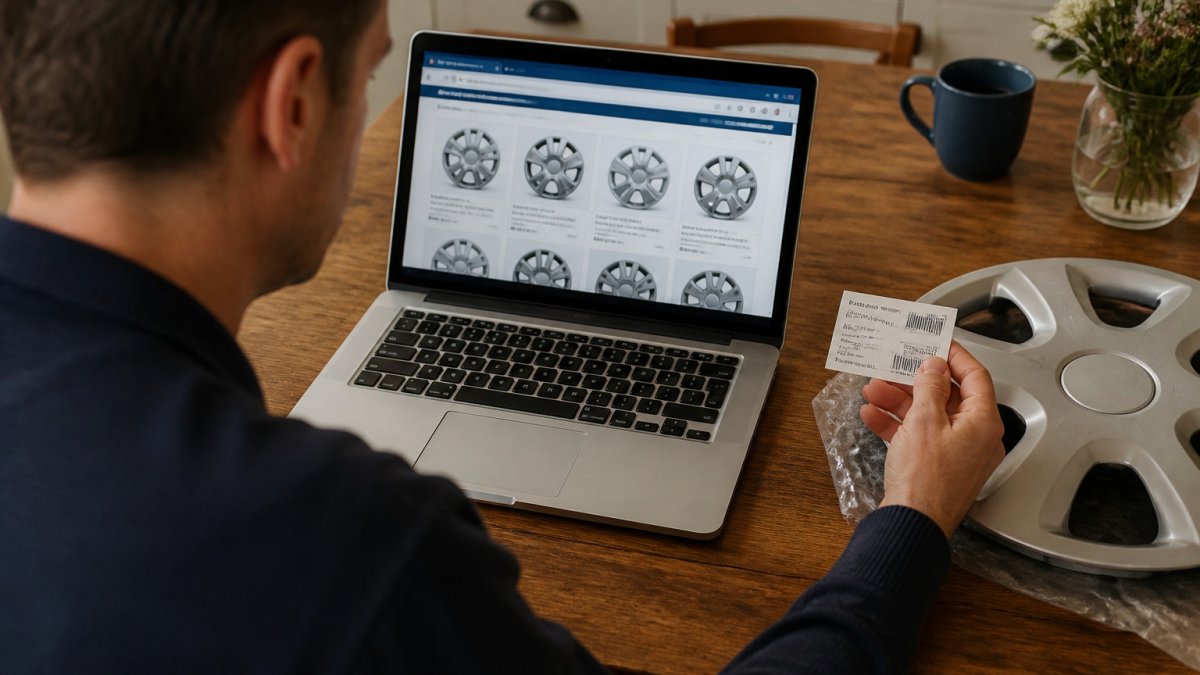
Watch for these signs:
- Spelling and grammar errors in product titles or descriptions
- Stock photos used for every product instead of photos of the actual item
- Logos that look blurry, stretched or slightly off-brand
- Product pages that repeat the same text with only a different part name
- A "countdown" timer or pressure to buy now
Pay special attention to the product photos. If the same image appears on several unrelated listings, or the pictures look too polished to come from the seller, ask for a close-up photo of the actual part before you order.
Way 4: Verify the Part Number and Manufacturer Markings
The part number is one of the most useful checks you have. Genuine components are usually marked with a manufacturer part number, and that number should match the listing and the fitment information.
Here is how to check it:
- Find the OEM number on your existing part or in your owner's documentation
- Search that number on the manufacturer's site or a trusted parts catalog
- Confirm the number on the listing matches what you found
- Look for markings, logos and print quality on any photos of the part itself
Be careful with listings that give no part number at all, or that use vague terms like "OEM style" without naming a number. Those listings leave you no way to confirm what you are buying.
Way 5: Confirm Vehicle Part Compatibility Before Checkout
A part can be genuine and still be the wrong one for your vehicle. Confirm fitment before you pay.
Give the seller your year, make, model and trim level, and check that the site asks for these details. Many good sites also let you enter your vehicle identification number (VIN) so the system can confirm the match. A seller that does not ask about your vehicle may be selling parts without checking whether they fit.
After you find a match, compare the part against your original component if you still have it. Check the mounting points, dimensions and connectors. This step saves you from a return and from a part that does not work.
Way 6: Check Payment Methods and Protect Your Personal Data
Payment is where a fake site does its real damage. A polished storefront costs nothing to build; a payment flow that protects you is harder to fake. Read this section before you type a card number anywhere.
Rank payment methods by the protection they give you
Not all payment methods are equal when something goes wrong. From strongest to weakest for an online parts order:
- Credit card, card issuers generally let you dispute a charge for goods that never arrived or were not as described. This is the strongest option for most buyers.
- Reputable payment services with buyer protection, many offer dispute processes, but the terms, deadlines and covered reasons vary. Read the specific program terms, not the marketing page.
- Debit card, protections exist but are generally weaker and the money leaves your account immediately, which can matter if you need cash for other bills while a dispute is open.
- Wire transfer, direct bank transfer, gift cards, cryptocurrency, payment apps to a personal handle, these offer little or no recourse. A legitimate retailer has no reason to demand them for a normal order.
Read the checkout page, not just the padlock
A padlock and an "https" address mean the connection is encrypted. They do not mean the seller is honest. A fake site can have a valid certificate. What matters is where your card details go:
- The checkout should stay on the seller's own domain. If you are redirected to an unrelated domain to pay, stop.
- The page should show a recognizable payment processor, not a generic form that asks for card number, expiration, CVV and your full billing details with no processor branding.
- The site should not ask you to email or text your card number. Ever.
- The order confirmation should come from the same domain as the store, with an order number you can reference.
What a parts order actually needs, and what it never needs
A normal order needs your name, shipping address, billing address, email, phone for delivery updates, and payment details. That is the list.
A parts order does not need your Social Security number, your driver's license number, your bank login, your card PIN, a photo of your ID, or your account password for any other service. If a site asks for any of those, close the tab. No legitimate parts retailer needs them to ship a wheel cover.
Signs your card details may already be compromised
Watch for these after checkout:
- A small test charge you do not recognize, often under a dollar, followed by a larger one
- An order confirmation for something you did not buy
- A password reset email you did not request
- A shipping notice for a package you did not order
- A sudden change in your card's available balance
These patterns are common in card-testing fraud, where stolen numbers are validated with small charges before larger ones. Report them to your card issuer immediately.
If you already shared card or account details
Act in this order:
- Call the number on the back of your card and ask the issuer to block the card and open a dispute for any unauthorized charge. Ask them to note the date and time you called.
- Change passwords on any account that used the same email and password combination, starting with your email account and any shopping or payment accounts.
- Turn on two-factor authentication where it is offered.
- Save everything, the listing URL, screenshots, order confirmation, emails and chat transcripts. Disputes move faster with a clean record.
- Report the site to the appropriate consumer fraud authorities. Reporting does not recover your money on its own, but it builds the record that helps other buyers and investigators.
- Watch your statements for several months. Fraudulent charges sometimes appear weeks after the original order.
Way 7: Review Warranty, Return Policy and Customer Feedback
A clear return policy is a strong sign of a real business. Read the terms before you buy and look for these details:
- How long you have to return an item
- Who pays return shipping
- Whether the seller offers a warranty, and what it covers
- How the seller handles damaged or wrong items
Then read customer feedback from more than one source. Reviews on the seller's own site may be curated, so check independent review platforms as well. Look for patterns, such as many people reporting the same problem. A handful of complaints may not mean much, but a steady stream of them deserves attention.
Look for that kind of openness on any site you consider.
What to Do If You Already Bought from a Fake Site
If you suspect you have already bought from a fraudulent seller, act quickly.
- Contact your card issuer or payment provider and dispute the charge.
- Save every email, receipt, order number and screenshot of the listing.
- Report the site to the Federal Trade Commission at ReportFraud.ftc.gov and to the Internet Crime Complaint Center at ic3.gov.
- Do not install parts from the order on your vehicle. Counterfeit components can fail and create a safety risk.
- Watch your accounts for unfamiliar activity over the following months.
Acting fast gives you the best chance of recovering your money and protecting your vehicle.
Shop With Confidence at WheelCovers.Com
The seven checks above help you separate legitimate sellers from fake ones, and they work whether you are buying a wheel cover, a trim ring or any other auto part. When you shop at WheelCovers.Com, you order from a family-owned supplier with nearly 50 years in the business and an inventory of over 1 million hubcaps, wheel covers, wheel skins and trim rings. Our online ordering is easy, and our shipping reaches customers across the country. Visit WheelCovers.Com to find the right fit for your vehicle, and check current prices and availability on our site.
Frequently Asked Questions
How can I tell if an auto parts website is legitimate?
Start with the seller's contact details. A legitimate retailer lists a physical business address, a working phone number and a customer service email, and its name matches the business registration you can look up in your state. Check whether the site uses a secure connection, lists a clear return policy and has customer reviews on independent platforms. If the company cannot be found outside its own website, or every review is identical, treat it as a warning sign and look for another seller before entering payment details.
What are the warning signs of a fake auto parts website?
Common warning signs include prices far below what other sellers charge for the same part, spelling and logo errors, stock photos instead of real product images, and no part numbers listed. Fake sites often push urgency with countdown timers, accept only wire transfers or gift cards, and offer no clear way to contact a person. Any one of these alone may not prove fraud, but several together should stop your purchase.
How can I verify that an auto part is genuine?
Compare the part number on the listing with the number stamped or printed on the part itself and with the number in the manufacturer's catalog. Check packaging for consistent print quality, correct logos and spelling, and tamper-evident seals. Ask the seller for the manufacturer's part number and confirm it through the manufacturer's website or an authorized dealer. Genuine parts also carry consistent material and finish quality, so a rough edge or uneven coating is a reason to question the source.
